If a member of the public is injured or their property is damaged during your daily operations, Waste Management Public Liability Insurance steps in to cover the resulting compensation claims and safeguard your business. Because of heavy machinery and public interaction, it is an essential safeguard for this industry.
Article At A Glance
- Public liability insurance is not legally mandatory for UK waste management businesses, but it is almost always required by waste licences, local authorities, and commercial contracts before you can operate.
- Waste management operations face significantly higher third-party risk than most industries due to heavy machinery, vehicle movements, public site access, and hazardous materials.
- Employers’ liability insurance is a legal requirement in the UK if you employ staff — and in waste management, this cover is especially critical given the day-to-day physical risk workers face.
- A single combined specialist insurance package is almost always more effective than piecing together generic policies — and understanding why could save your business from a costly coverage gap.
- West Craven Insurance specialises in commercial cover for businesses in higher-risk sectors, including waste and recycling operations across the UK.
Running a waste management business in the UK without the right insurance in place is not just risky — it can shut your operation down entirely.
Whether you run a skip hire company, a recycling centre, or a controlled waste collection service, the exposure your business faces every single day goes well beyond what a standard commercial policy is designed to handle. Third-party injuries, vehicle incidents, environmental damage, machinery failures — these are not edge cases in this sector. They are everyday realities.
West Craven Insurance works with businesses in exactly this position, helping operators find cover that actually reflects the work they do rather than a generic template built for lower-risk trades. Understanding what public liability insurance covers — and what it does not — is the starting point for getting this right.
Public Liability Insurance for UK Waste Management: What You Need to Know
Public liability insurance is designed to protect your business if a member of the public is injured, or their property is damaged, as a result of your operations. If a claim is made against you, your policy covers the legal defence costs and any compensation payout — both of which can run into tens of thousands of pounds before a case is even resolved.
Why Generic Business Insurance Falls Short in This Sector
Standard public liability policies are priced and structured around lower-risk businesses — consultants, retailers, tradespeople. Waste management operates in a completely different risk environment. Heavy goods vehicles reversing onto public roads, excavators and compactors running near members of the public, skips left on highways, processing sites with open access — none of these exposures are adequately accounted for in a generic policy.
When a claim arises, insurers look closely at whether the activity that caused the incident was actually covered under the policy wording. Generic policies often contain exclusions for vehicle movements beyond the road, pollution events, or operations involving controlled waste. That gap between what you think is covered and what the policy actually pays out is where businesses get into serious financial trouble.
The Legal Baseline: What Is and Is Not Mandatory
Public liability insurance itself is not a legal requirement under UK law. However, in practice, operating without it is rarely possible. Environment Agency waste carrier licences, local authority contracts, site landlords, and commercial clients routinely require proof of public liability cover — often at a minimum limit of £5 million — before any work can begin.
Employers’ liability insurance is different. Under the Employers’ Liability (Compulsory Insurance) Act 1969, any UK business that employs staff must hold a minimum of £5 million in employers’ liability cover. In practice, most insurers issue policies at £10 million as standard. Failure to hold valid cover can result in fines of up to £2,500 per day.
What Public Liability Insurance Actually Covers
At its core, a public liability policy covers two things: compensation paid to a third party who has suffered injury or property damage linked to your business, and the legal costs of defending the claim. In a sector like waste management, both of these can escalate quickly.
Third-Party Injury Claims on Site and During Operations
If a member of the public is injured at one of your sites — whether that is a recycling centre, a skip yard, or a transfer station — and they hold your business responsible, your public liability insurance responds to that claim. The same applies during active operations. A pedestrian struck by debris during a waste collection, a vehicle customer injured on a depot forecourt, a contractor hurt by equipment your team was operating — all of these scenarios can result in a claim against your business.
Property Damage During Collection, Transport, and Processing
Property damage claims are just as common as injury claims in this sector, and often just as expensive. A skip dropped incorrectly can damage a driveway, a kerb, or a parked vehicle. A waste collection vehicle reversing can take out a garden wall or commercial fencing. During processing, material can shift or fall and damage structures or third-party equipment nearby.
Your public liability policy covers the cost of repairing or replacing the damaged property, along with any legal costs if the claimant pursues the matter formally. Some of the most frequent property damage scenarios waste management businesses face include:
- Skip placement causing damage to tarmac, paving, or kerbing at a customer’s premises
- Reversing HGVs striking gates, walls, or parked vehicles during collection
- Falling materials from loaded vehicles or processing equipment damaging adjacent property
- Spillage from waste containers causing damage to road surfaces or drainage systems
- Forklift or plant machinery contact with third-party structures on or near your site
Each of these incidents can generate a claim worth thousands of pounds. Without the right cover in place, your business absorbs that cost directly.
Legal Costs and Compensation Payouts
Legal defence costs alone can be significant even when your business is not at fault. Solicitor fees, expert witness reports, court costs, and case management can run to five figures for a relatively straightforward claim. If the case goes against you, the compensation payout on top of that can be substantial — particularly where a claimant has suffered a serious injury with long-term consequences.
This is why the level of cover you hold matters as much as having a policy at all. A £1 million limit may sound significant, but in a sector with this level of exposure, it can be exhausted quickly by a single serious incident involving multiple claimants or complex legal proceedings.
Why Waste Management Businesses Face Elevated Risk
The waste and recycling sector consistently sits among the higher-risk categories for commercial insurers — and for good reason. The combination of heavy equipment, public-facing operations, hazardous materials, and high vehicle activity creates a risk profile that most industries simply do not share.
Heavy Machinery, Vehicle Movements, and Manual Handling Hazards
Waste management operations routinely involve equipment and vehicle types that carry significant injury potential. Compactors, shredders, balers, excavators, skip loaders, and refuse collection vehicles all operate in environments where members of the public may be present. Manual handling of heavy or awkward waste items adds another layer of exposure, both for workers and for anyone in the vicinity.
Vehicle movements in particular generate a disproportionate number of claims in this sector. Large vehicles reversing in confined spaces, operating on public roads during collections, or navigating customer premises create frequent opportunities for third-party contact. The weight and size of these vehicles means that even low-speed incidents can result in serious property damage or injury.
Public Access Points: Depots, Skip Sites, and Roadside Collections
Many waste management businesses operate sites with regular public or customer access. Recycling centres and household waste facilities deal with large volumes of members of the public daily. Skip hire depots receive visiting customers. Roadside collections bring vehicles and crews into direct contact with pedestrians and other road users throughout their working day. For more information on securing these sites, explore waste transfer station insurance.
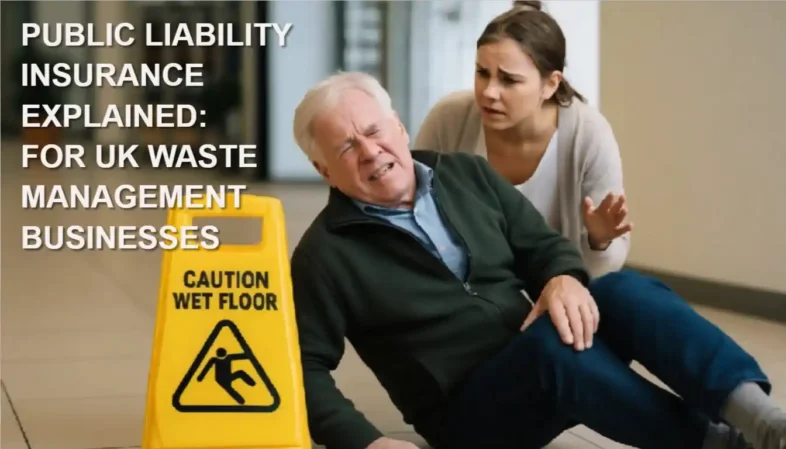
Every one of these access points is a potential liability exposure. A customer slipping on a wet surface at your depot, a pedestrian tripping over equipment left on a pavement during a collection, or a road user involved in an incident with one of your vehicles — each scenario can generate a public liability claim your business needs to be prepared for.
Environmental Exposure and Pollution Risk
Standard public liability policies almost always exclude pollution and contamination events. For most businesses, this is not a significant gap. For waste management operators, it can be the most important exclusion in the entire policy document.
Accidental spills during transport, leachate escaping from a poorly secured load, contaminated runoff from a processing site, or airborne particulates from a recycling operation can all trigger environmental damage claims. These claims are handled under separate environmental or pollution liability cover — something that needs to be arranged deliberately as part of a specialist waste management insurance package, not assumed to be included in a standard public liability policy.
The cost of an environmental incident can extend well beyond immediate clean-up costs. Regulatory investigations, third-party claims for property or health damage, and remediation requirements can combine to produce a liability that dwarfs what most businesses expect. Getting this cover in place before an incident occurs is not optional in this sector — it is fundamental.
Employers’ Liability Insurance: The Legal Requirement You Cannot Ignore
If public liability insurance is the cover you should have, employers’ liability insurance is the cover you must have. The distinction matters because the consequences of getting it wrong are not just financial — they are legal. In the waste management sector, where physical risk is part of daily operations, this is not a policy you want to be without for a single working day.
Workers in waste and recycling face injury risks that most employees in other industries will never encounter. Manual handling of heavy and awkward materials, working around moving plant and vehicles, exposure to hazardous or controlled waste, operating in all weather conditions on uneven ground — the potential for workplace injury is high, and the claims that result can be significant. Employers’ liability cover exists precisely to protect your business when those incidents happen.
Who Is Legally Required to Hold This Cover in the UK
Under the Employers’ Liability (Compulsory Insurance) Act 1969, any business operating in the UK that employs one or more members of staff is legally required to hold employers’ liability insurance with a minimum limit of £5 million. Most insurers issue this at £10 million as standard. The policy must be held with an authorised insurer, and your current certificate of insurance must be displayed — or made available to employees — at all times. The Health and Safety Executive (HSE) can issue fines of up to £2,500 for every day a business operates without valid cover in place.
How It Works Alongside Public Liability Insurance
Public liability insurance covers claims made by third parties — members of the public, customers, contractors, or other people outside your workforce. Employers’ liability covers claims made by your own employees if they are injured or become ill as a result of their work. The two policies operate independently but are almost always arranged together as part of a combined commercial insurance package. In the waste management sector, both covers are essential, and both need to reflect the actual risk level of your operations rather than being set at the lowest available limit.
Other Cover Types Waste Management Businesses Should Consider
Public liability and employers’ liability form the foundation of any waste management insurance programme, but they do not cover everything. The nature of this sector means there are several additional exposures that need to be addressed through specific policy types — and leaving any of them uninsured creates a vulnerability that a single incident can expose.
The good news is that specialist waste management insurance packages are designed to bring these covers together under a single policy or coordinated programme. Rather than approaching each risk separately through different insurers, working with a specialist broker means you can arrange comprehensive cover that addresses your full risk profile without duplication or dangerous gaps between policy sections.
What that package looks like will vary depending on the size of your operation, the types of waste you handle, the number of vehicles you run, and whether you operate one site or several. The sections below outline the key additional cover types that most waste management businesses will need to consider when building out their programme.
Motor Fleet and Commercial Vehicle Insurance
Waste management businesses are vehicle-dependent, and that fleet represents one of your biggest areas of liability. From skip lorries and roll-on roll-off vehicles to tipper trucks and crew cabs, each vehicle needs to be correctly insured for the specific activities it carries out. A standard commercial vehicle policy may not cover specialist bodywork, loading and unloading operations, or vehicles that travel off the public road onto site. Motor fleet insurance for waste operators needs to be arranged with full knowledge of the vehicle types, their usage, and the environments they operate in.
Plant and Machinery Cover
Excavators, compactors, balers, shredders, conveyor systems, and forklifts are expensive assets and critical to your operation. Plant and machinery insurance covers breakdown, accidental damage, and in some cases theft of mobile plant. Given the cost of replacing or repairing specialist waste processing equipment — and the operational downtime that comes with it — this cover is not a luxury. A baler that fails mid-week or a compactor damaged by an overloaded feed can bring a processing operation to a standstill within hours.
Environmental and Pollution Liability Insurance
As covered earlier, standard public liability policies exclude pollution and contamination events almost without exception. Environmental liability insurance fills that gap. It covers clean-up costs, third-party compensation for environmental damage, regulatory defence costs, and remediation expenses following an accidental pollution incident. For any business handling controlled waste, liquid waste, or materials with contamination potential, this is a non-negotiable part of a complete insurance programme. Insurers arranging this cover will want to see evidence of your waste carrier licences, site permits, spill management procedures, and compliance history before quoting.
Business Interruption Insurance
If a fire, flood, equipment failure, or major incident forces your site to close or significantly reduces your operating capacity, business interruption insurance covers the resulting loss of income. For waste management businesses with fixed overhead costs — vehicle finance, staff wages, site leases — even a short period of disruption can put serious financial pressure on the business. This cover bridges the gap between when an incident occurs and when normal operations resume. For more information on protecting your facility, consider exploring industrial site insurance options.
Business interruption cover is typically arranged alongside your property or material damage insurance and triggered when an insured event causes an interruption to your revenue. The indemnity period — the length of time the policy will pay out — needs to be set realistically. In a sector where specialist equipment may have long lead times for repair or replacement, a 12-month indemnity period is often the minimum that makes practical sense.
Goods in Transit and Professional Indemnity
If your business collects, transports, or brokers waste on behalf of third parties, goods in transit insurance covers the load while it is in your vehicle or under your care. This is distinct from your vehicle insurance and responds to loss, damage, or contamination of the waste material itself during transit. Professional indemnity cover becomes relevant for waste consultants, compliance advisors, or brokers who provide guidance or recommendations to clients — protecting the business if that advice leads to a financial loss or regulatory breach the client holds you responsible for.
Which UK Waste Businesses Most Often Need Specialist Insurance
The short answer is: all of them. But the specific shape of a specialist policy varies considerably depending on what type of waste operation you run. The risks faced by a domestic skip hire company differ significantly from those of a hazardous waste processor or a large-scale materials recovery facility, even if their core insurance needs overlap.
What they all share is that their risk profile sits outside the scope of general commercial insurance. The businesses below illustrate why specialist cover is the only appropriate approach in each case.
Skip Hire Operators and Waste Collection Companies
Skip hire businesses have a unique public liability exposure because their equipment is left on public and private land, often for extended periods, without anyone from the business present. A skip positioned on a public highway must comply with local authority permit conditions, carry appropriate lighting and markings, and be placed in a way that does not create an unreasonable hazard. If a member of the public is injured because of an unsecured or poorly placed skip, the claim comes back to the operator. Public liability cover for skip hire needs to specifically include liability arising from skips left in public or customer locations, not just liability during active delivery and collection operations.
Recycling Centres, Transfer Stations, and Scrap Yards
These operations typically combine high volumes of public or commercial customer access with active plant and vehicle movements on the same site. A member of the public dropping off recycling material may be on site at the same time as a loading shovel or HGV is operating nearby. That interaction between public access and heavy operational activity is where liability exposure concentrates. Specialist insurance for these sites needs to account for the full range of activities taking place simultaneously — not just the public-facing element or the operational element in isolation. For comprehensive coverage, consider exploring industrial site insurance options.
Hazardous and Controlled Waste Handlers
Businesses that handle hazardous or controlled waste operate under the most stringent regulatory requirements in the sector — and face the most complex insurance challenges. Controlled waste handlers must hold appropriate Environment Agency permits, maintain detailed waste transfer documentation, and demonstrate robust procedures for storage, containment, and disposal. Insurers will scrutinise all of this before offering terms, and some standard commercial insurers will decline this class of risk entirely.
For hazardous waste operators, environmental and pollution liability cover is not an optional add-on — it is a core part of the insurance programme. A spill, leak, or improper disposal event involving hazardous materials can trigger regulatory action, third-party claims, and remediation costs simultaneously. The liability exposure from a single incident can be substantial, and the only effective way to manage it is through specialist cover arranged with an insurer who understands the specific waste streams your business handles.
How to Choose the Right Level of Public Liability Cover
Choosing a cover limit is not about picking a number that sounds adequate — it is about matching your policy to the realistic worst-case scenario your business could face. In the waste management sector, that scenario is often more serious than operators initially anticipate. A single incident involving a member of the public, a contractor, or a neighbouring property can generate a claim that moves through legal proceedings for years before it is resolved, with costs accumulating at every stage.
The starting point for most waste management businesses is a public liability limit of £5 million, which is the minimum level commonly required by waste carrier licences and local authority contracts. Many operators — particularly those running larger fleets, processing sites, or hazardous waste streams — will need £10 million or more to adequately reflect their exposure. The limit you choose should be driven by the scale of your operation, the environments you work in, and the contractual requirements of your clients, not by the desire to minimise premium costs.
Matching Cover Limits to Your Operation Size and Risk Profile
A sole trader running a single skip lorry faces a fundamentally different risk profile from a business operating a multi-vehicle fleet, a large transfer station, and a public-facing recycling centre. Cover limits need to scale accordingly. Factors that typically indicate a higher limit is needed include operating on public highways regularly, working near residential or commercial properties, handling controlled or hazardous waste, running a high-footfall public site, or holding contracts with large commercial or public sector clients who specify minimum insurance requirements in their terms.
It is also worth reviewing your cover limits annually, not just at renewal as a formality. If your business has grown — more vehicles, new sites, increased waste volumes, new waste types — your risk profile has changed. A limit that was appropriate two years ago may leave you exposed today. Your insurer or broker should be prompting this conversation, but the responsibility ultimately sits with you as the business owner to make sure your cover keeps pace with your operations.
What Insurers Assess When Quoting for Waste Management Policies
When a specialist insurer assesses a waste management risk, they are building a detailed picture of your operation. They will want to know the types of waste you handle and whether any of it is classified as hazardous or controlled, the number and type of vehicles in your fleet, the sites you operate from and who has access to them, the plant and machinery you use, your claims history, your Health and Safety procedures and training records, and whether you hold all relevant Environment Agency licences and permits. The more clearly and thoroughly you can present this information, the more accurately your premium will reflect your actual risk — and the less likely you are to encounter exclusions or limitations in the policy wording that could undermine your cover when you need it.
Single Policy vs. Combined Specialist Insurance Package
For most waste management businesses, a combined specialist insurance package arranged through a broker with experience in this sector will offer better value and more complete protection than a collection of separately arranged generic policies. A combined package ensures that the different sections of your cover are written consistently, with no gaps between liability, vehicle, plant, environmental, and property sections. It also simplifies your administration, gives you a single point of contact for claims, and makes it easier to demonstrate your full insurance position to clients, regulators, and licensing authorities who require proof of cover.
Build Your Policy Around Your Operation, Not the Other Way Around
The most common mistake waste management businesses make with insurance is treating it as a compliance exercise rather than a risk management tool. Buying the minimum cover needed to satisfy a licence condition or a client contract gets you through the door — but it does not protect your business when something goes seriously wrong. The businesses that come through major incidents intact are the ones that took the time to understand their actual exposure, worked with a broker who knew the sector, and built a policy that reflected reality rather than a best-case assumption about what might happen.
Frequently Asked Questions
| Cover Type | What It Covers | Legally Required? | Typical Minimum Limit |
|---|---|---|---|
| Public Liability | Third-party injury and property damage claims | No — but required by most licences and contracts | £5 million |
| Employers’ Liability | Employee injury and illness claims | Yes — under the 1969 Act | £5 million (£10 million standard) |
| Environmental Liability | Pollution incidents, clean-up, and remediation costs | No — but essential for controlled/hazardous waste | Varies by risk profile |
| Motor Fleet | Third-party and vehicle damage during operations | Yes — third-party cover required by law | Varies by fleet size |
| Plant and Machinery | Breakdown, accidental damage, and theft of equipment | No | Based on asset value |
| Business Interruption | Lost income following an insured event | No | Based on annual turnover |
Is Public Liability Insurance a Legal Requirement for Waste Management Businesses in the UK?
Public liability insurance is not a legal requirement under UK law, but in practice it is almost always a contractual or regulatory requirement. The Environment Agency, local authorities, site landlords, and commercial clients routinely require proof of public liability cover — typically at a minimum of £5 million — before granting licences, awarding contracts, or permitting site access. Operating without it is technically possible, but practically it will prevent your business from working legally and commercially in most circumstances. For businesses involved in waste management, having the right insurance is crucial, and you can learn more about waste transfer station insurance to ensure comprehensive coverage.
Does Public Liability Insurance Cover Environmental Damage or Pollution Incidents?
Standard public liability policies almost universally exclude pollution and contamination events. If your business causes an environmental incident — a spill during transport, leachate from a poorly secured load, contaminated runoff from a site — a standard public liability policy will not respond to the resulting claims or remediation costs. Environmental and pollution liability cover must be arranged separately and specifically as part of a specialist waste management insurance programme. For any business handling controlled or hazardous waste, this cover is essential, not optional.
Can I Cover Multiple Waste Sites Under a Single Public Liability Policy?
Yes, in most cases a single public liability policy can be extended to cover multiple operating locations. This is one of the advantages of working with a specialist broker who can arrange a combined policy that reflects your full operational footprint. Each site will need to be declared to the insurer, with details of the activities carried out, the level of public access, and any specific risks associated with that location, such as those related to energy from waste insurance.
It is important not to assume that adding a new site automatically extends your existing cover. Any new location should be notified to your insurer promptly. Failure to declare a site could mean that incidents occurring there are not covered, even if the rest of your programme is in good order. Keep your broker informed whenever your operational footprint changes — new sites, new activities, or significant changes to how an existing site operates. For more information on the necessary coverage, you can refer to what insurance waste recycling businesses need.
What Is the Difference Between Public Liability and Employers’ Liability Insurance?
The distinction comes down to who is making the claim. Public liability insurance responds to claims made by people outside your workforce — members of the public, customers, visitors, or contractors — who suffer injury or property damage as a result of your business activities. Employers’ liability insurance responds to claims made by your own employees if they are injured or become ill due to their work.
- Public Liability: Covers third-party claims — injury or damage to people and property outside your business
- Employers’ Liability: Covers employee claims — injury or illness sustained as a result of their employment
- Legal status: Public liability is not legally mandatory; employers’ liability is required by law for all UK businesses with staff
- Who it protects: Both ultimately protect your business from the financial impact of compensation and legal costs
- Coverage trigger: Public liability is triggered by a third-party incident; employers’ liability by a workplace injury or occupational illness claim from a member of your team
In the waste management sector, both covers are equally important because your business faces significant exposure on both fronts. The physical nature of waste management work means employee injury claims are a real and ongoing risk, while the public-facing elements of your operation create constant third-party liability exposure.
The two policies are almost always arranged together as part of a combined commercial insurance package. Trying to arrange them separately through different insurers can create complications at the claims stage — particularly where an incident involves both an employee and a third party simultaneously, which is not unusual in this sector.
Make sure both limits are set at a level that reflects your actual risk. The legal minimum for employers’ liability is £5 million, but most policies are issued at £10 million as standard. For public liability, the minimum required by many contracts and licences is £5 million, but larger operations should consider whether £10 million or more is more appropriate given their scale and exposure.
How Much Public Liability Cover Does a UK Waste Management Business Typically Need?
The minimum that most waste management businesses will encounter as a contractual or licensing requirement is £5 million. This is the level commonly specified by Environment Agency waste carrier licences, local authority contracts, and commercial client agreements. For smaller operators — a sole trader with a single vehicle and limited public-facing activity — this may be a sufficient starting point.
For businesses with a larger operational footprint, a £5 million limit is often not enough to reflect the realistic worst-case claim scenario. A serious injury to a member of the public involving an HGV, or a significant property damage incident at a commercial client’s premises, can generate legal and compensation costs that approach or exceed this level when fully accounted for. Many waste management operators arrange cover at £10 million as a more prudent baseline.
Businesses operating processing sites with regular public access, running large vehicle fleets, handling hazardous or controlled waste, or holding contracts with public sector organisations will often need to consider limits of £10 million or above. Some public sector contracts specify minimum public liability limits of £10 million as a standard tender condition. It is worth reviewing your contractual obligations carefully before settling on a limit.
You may also find additional resources on this topic at “Waste Management Insurance UK: What Facility Operators Need to Know”