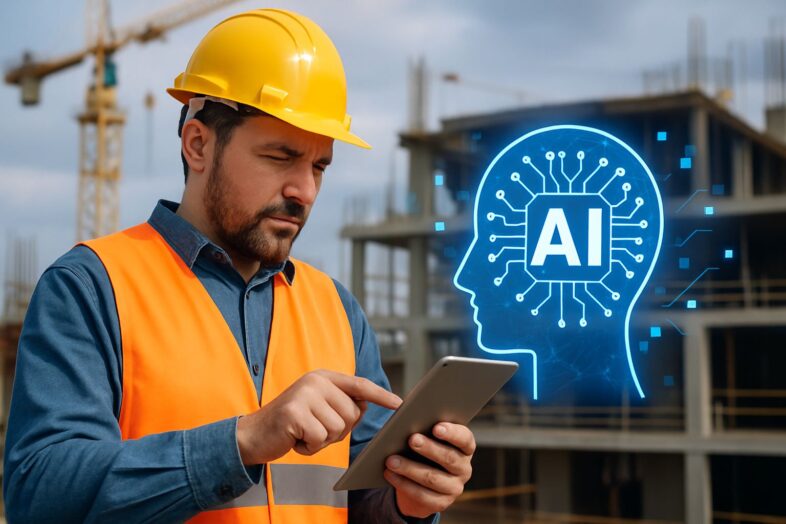
AI in construction is no longer a futuristic concept; it is currently a multi-billion dollar market expected to reach nearly $12 billion by 2029. It is being used across the entire project lifecycle—from design and bidding to on-site safety and long-term facility management—to combat chronic industry challenges like labour shortages and low productivity.
Key Takeaways for Construction AI
- AI is actively reshaping construction — from early-stage design and scheduling to on-site safety monitoring and supply chain management, smart construction solutions are no longer experimental.
- Predictive analytics and machine learning can flag project risks, cost overruns, and material shortages before they happen, giving project managers a critical edge.
- Digital twins and AI-enhanced BIM are creating virtual replicas of construction projects that update in real time — a game-changer for clash detection and quality control.
- Autonomous equipment, drones, and robotics are reducing labor-intensive tasks and improving precision on job sites worldwide — keep reading to find out which technologies are gaining the most traction.
- AI won't eliminate construction jobs — but firms that adopt these tools will outperform those that don't, and the gap is widening fast.
AI in Construction Is No Longer a Future Concept — It's Here Now
The construction industry is in the middle of a technological revolution, and the firms paying attention are pulling ahead fast.
For years, the construction industry was behind the curve when it came to digital adoption. But now, the pace of change is impossible to ignore. AI-powered tools are becoming integral parts of project planning software, safety monitoring systems, procurement platforms, and even the physical equipment used on job sites. The question is no longer if AI will revolutionize construction — it's how quickly your firm will adapt to it. Platforms like Smart Construction Solutions are already helping construction professionals navigate this transition, providing insight into the tools and strategies that are reshaping the industry worldwide.
There's a lot on the line. Every year, construction projects around the globe lose hundreds of billions of dollars to delays, cost overruns, and inefficiencies. AI is designed to directly address these issues — and the data supports this. Autodesk reports that companies that incorporate AI into their construction software are seeing noticeable enhancements in the accuracy of project predictions, the optimization of resources, and safety results.
In this article, we're going to take a look at all of the major smart construction innovations that you need to be aware of. We'll cover everything from autonomous machinery to AI-driven sustainability modeling, so you can make an informed decision about where technology fits into your workflow.
1. Project Planning and Design Powered by AI
Project planning has traditionally been one of the most complex challenges in the construction industry. There are too many variables, too many stakeholders, and too much room for human error. AI is revolutionizing this process by processing data on a scale that no human team can compete with.
Generative AI's Impact on Preliminary Design
With generative AI tools, architects and engineers can input project restrictions such as site dimensions, budget constraints, preferred materials, and local building codes. They will then receive hundreds of optimized design variations in minutes. Tools like Autodesk's generative design engine produce more than just aesthetically different options. They also model structural performance, energy efficiency, and cost all at once. This process used to take weeks of back-and-forth between design teams, but now it can be done in a single session.
The pre-construction phase is significantly shortened. Design teams can evaluate trade-offs immediately and come to client presentations with recommendations backed by data rather than proposals driven by intuition. For companies working on tight deadlines or complex builds, this speed is a real competitive edge. For those interested in the technical aspects, there are various landfill designs and operations that can offer insights into efficient construction methods.
Forecasting Analytics for Intelligent Project Scheduling
Scheduling tools powered by AI examine past project data, weather trends, team availability, and material lead times to construct timelines that consider real-world unpredictability. Rather than unchanging Gantt charts that become outdated as soon as something changes, these tools produce flexible schedules that automatically update as circumstances change on site. Learn more about AI in construction and how it's transforming project management.
Machine learning models, which have been trained on thousands of past projects, can identify which schedule dependencies are most likely to cause cascading delays. These models can flag these potential issues before they become problems. This kind of early warning system is invaluable on large-scale infrastructure or commercial builds, where a single bottleneck can cost millions.
Cost Estimation and Budget Forecasting Powered by AI
Estimating costs traditionally has been dependent on the experience of individual estimators and historical unit pricing. However, AI-powered estimation tools use much larger datasets — including regional labor rates, real-time material pricing, supplier performance data, and project-specific risk factors — to produce estimates that are more accurate and more defensible.
- Companies like ALICE Technologies and Buildots use AI to create thousands of construction sequencing options and find the most cost-effective approach.
- Machine learning powers real-time budget dashboards that update cost forecasts as project conditions change, not just at milestone reviews.
- Risk-adjusted forecasting assigns probability scores to budget overruns based on project type, location, and team composition.
- Automated quantity take-offs from 3D models reduce manual measurement errors that have historically inflated contingency budgets.
This results in a shift from reactive budget management — discovering overruns after they happen — to proactive financial control throughout the project lifecycle. For more insights, explore the AI advancements in construction.
2. Self-Driving Construction Equipment and Robotics
Self-driving equipment is no longer just a theory being tested in labs. It's operating on real construction sites right now, handling everything from grading and excavation to precise structural assembly. The combination of GPS, LiDAR, computer vision, and real-time machine learning is turning heavy equipment into precision instruments. For more insights into the technology behind these advancements, explore the latest separation and sorting technology developments.
- Komatsu's Smart Construction platform employs drone surveys and AI to generate 3D site maps, which are then transmitted directly to semi-autonomous bulldozers and excavators for precise earthmoving.
- Built Robotics has created an AI guidance system that transforms regular excavators into fully autonomous machines that can function without a human operator in the cab.
- Trimble's machine control systems use real-time grade data to guide operators with millimeter-level precision, significantly reducing rework on grading and paving operations.
The labor shortage is one of the most critical problems facing construction worldwide, and autonomous equipment directly addresses this issue. Machines don't require breaks, don't make fatigue-related mistakes, and can work in hazardous conditions that would endanger human workers.
Self-Operating Vehicles and Heavy Equipment on Construction Sites
Automated haul trucks are already being utilized in large mining and earthwork projects. Companies such as Caterpillar and Volvo are developing fully automated haul truck systems that are specifically designed for construction operations. These vehicles use AI to navigate the terrain of the site, avoid any obstacles, and coordinate with other equipment in real time — all without the need for human intervention.
Robotic Bricklaying, Welding, and Concrete Pouring
The SAM100 (Semi-Automated Mason) by Construction Robotics can lay between 300 and 400 bricks per hour — roughly three to five times the output of a skilled human mason — while maintaining consistent mortar application and alignment. For repetitive structural tasks, this level of throughput is transformative. Similarly, robotic welding arms used in modular construction facilities are achieving weld quality that exceeds manual standards while operating continuously across multiple shifts.
Robots that pour concrete and are equipped with sensor feedback can adjust the rate of pour and vibration patterns in real time. This helps to eliminate voids and ensure a uniform structural integrity. This is a critical step in quality control that has historically relied entirely on the experience of the operator.
The Rise of Drone Usage in Construction Site Surveys
Traditional site surveys are slow, costly, and prone to mistakes. Drones, however, when fitted with photogrammetry software and LiDAR sensors, can survey a whole construction site in mere hours. They can also generate precise 3D point cloud models that can be directly inputted into BIM platforms. DJI's Phantom 4 RTK and Trimble UX5 are two examples of survey-grade drones that are now frequently used on commercial construction sites.
Not only are drones being used for preliminary surveys, but they are also being used to monitor progress continually. They automatically compare the existing site conditions with the project model to detect any discrepancies and report them to the project managers. This eliminates the need for anyone to physically inspect the site.
3. Job Site Safety Monitoring Enhanced by AI
Construction is still one of the most hazardous industries worldwide. In just the United States, the construction industry is responsible for a significant number of workplace deaths each year. AI-enabled safety systems are addressing this issue in several ways — identifying risks as they happen, keeping track of worker health, and forecasting hazardous situations before accidents happen.
AI's greatest contribution to the construction industry is the move from reactive to predictive safety management. Instead of analyzing incidents after they occur, AI systems now recognize the conditions that lead to those incidents and intervene before anyone is injured.
Real-Time Hazard Detection with Computer Vision Systems
Continuously monitoring worker behavior across job sites, AI-powered camera systems can instantly flag safety violations as they happen. Systems such as Smartvid.io and viAct utilize computer vision to identify missing personal protective equipment (PPE), workers entering restricted areas, unsecured loads, and unsafe proximity to operating machinery — all in real time. Alerts are immediately sent to site supervisors, allowing for immediate intervention instead of a post-incident review. For more on these advancements, explore AI in construction.
Wearable Technology That Monitors Worker Fatigue and Vital Signs
Smart wearable technology is introducing a biological aspect to job site safety. Tools like the Kenzen ECHO H2 patch track core body temperature, heart rate, and sweat rate to predict heat stress before a worker begins showing symptoms. The SmartCap Technologies fatigue monitor uses EEG sensors in a standard hard hat to monitor brainwave activity and notify supervisors when a worker's alertness decreases to unsafe levels. These devices are not prototypes — they are currently being used on active construction sites.
4. When AI and Building Information Modeling (BIM) Combine
For years, the construction industry has relied on BIM as a key technology. However, the introduction of AI into BIM workflows has opened up a world of possibilities that extend far beyond 3D modeling. AI takes BIM from being a documentation tool to a dynamic, predictive intelligence platform that actively directs decision-making throughout the entire project lifecycle.
What makes the combination so potent is that BIM already compiles vast amounts of project data — geometry, materials, systems, schedules, costs. AI is the analytical engine that can extract valuable insights from that data at a speed and depth that no human team can match.
How AI Enhances Standard BIM Processes
Standard BIM processes are primarily human-oriented — designers input data, coordinators review models, and project managers interpret outputs. AI automates substantial parts of this process. Machine learning algorithms can analyze a BIM model and automatically identify inconsistencies, suggest optimizations, and generate updated cost forecasts as design changes are made. Natural language processing tools allow project teams to query BIM data conversationally — asking questions like “What is the current material cost variance for Level 3 structural steel?” and receiving immediate, data-backed answers.
Preventing Errors and Detecting Clashes Before Starting Construction
Clash detection used to be one of the most time-consuming coordination tasks in construction. It required teams of engineers to manually check model intersections across architectural, structural, and MEP systems. AI-powered clash detection tools like Autodesk Navisworks and Solibri Model Checker can now scan entire building models in minutes. They can identify not just hard clashes (physical intersections) but also soft clashes (clearance violations) and workflow clashes (scheduling conflicts). Even better, AI can rank clashes by severity and suggest resolution options. This drastically cuts down on the coordination hours needed before a single shovel hits the ground. For more on how technology is transforming industries, explore the circular economy in fashion.
Digital Twins: Simulating Your Construction Project in Real Time
A digital twin is a dynamic, data-fueled virtual double of a physical construction project that evolves in real time as conditions on the ground shift. Unlike a fixed BIM model, a digital twin pulls in live data from IoT sensors, drones, wearables, and construction management software to maintain a perpetually accurate depiction of what's really going on — not just what was supposed to happen. Platforms like Bentley Systems' iTwin and Dassault Systèmes' 3DEXPERIENCE are at the forefront of this field, allowing project teams to conduct simulations, test scenarios, and pinpoint risks against a model that mirrors real-world conditions at all times.
The benefits are significant. With this technology, project managers can see schedule changes as soon as they happen, instead of waiting weeks to find out during a progress review. Structural engineers can monitor how well a load is performing against the design specifications in real time. Facility managers who are taking over a completed building receive a fully populated digital twin that can be used as the basis for intelligent building operations. This is a big improvement over the traditional hand-off, which involved stacks of paper documentation that were outdated before the ink even dried.
5. Intelligent Materials and Construction Sites Connected via IoT
Today's construction site is quickly evolving into a networked environment where materials, equipment, and people all produce and share data. This is made possible by the Internet of Things (IoT), which embeds sensors in everything from concrete pours to worker helmets to crane cables. When this data is fed into an AI platform, it provides a degree of operational transparency that was unthinkable ten years ago. For more insights, explore the AI breakthroughs in construction.
Smart materials and IoT are particularly effective because they change construction monitoring from occasional inspections to continuous, automated supervision. Instead of a structural engineer visiting a site weekly to evaluate progress, sensors embedded in the structure itself are reporting live data 24/7 — identifying anomalies as soon as they happen rather than during the next planned review. For more on technology in waste management, check out the latest separation and sorting technology.
Live Data Reporting from Sensors Embedded in Structures
Smart concrete — IoT sensors embedded in the mix — can monitor its own curing process in real time, reporting temperature, humidity, and compressive strength data directly to project management platforms. Giatec's SmartRock wireless concrete sensors are already widely deployed on commercial and infrastructure projects, allowing engineers to make pour-stripping and loading decisions based on actual concrete maturity rather than conservative wait times prescribed by standard specifications. The result is faster construction cycles without compromising structural safety — a balance that was previously very difficult to achieve consistently.
Coordinating Equipment, Workers, and Timelines with IoT Devices
IoT platforms such as Assignar and Triax Technologies' Spot-r system provide a real-time dashboard that connects workers, equipment, and materials. Workers are equipped with RFID clips or connected devices that track their location and activity status. Equipment is tracked using GPS and utilization sensors that measure idle time, fuel consumption, and operational hours. This data is fed into an AI scheduling engine, which can automatically reassign resources, identify underutilized equipment, and predict where bottlenecks are forming on the critical path — all without a project manager having to manually chase updates across multiple channels.
6. AI for Green Construction and Sustainability
Sustainability is no longer a choice in the construction industry — it's a regulatory requirement in many markets and a client expectation in almost all of them. AI is showing to be one of the most efficient tools available for achieving ambitious environmental goals without sacrificing project economics. From reducing material waste to modeling carbon emissions, smart construction solutions are making green building quicker, less expensive, and more quantifiable.
Minimizing Waste Through AI-Enhanced Material Utilization
The construction industry is a leading contributor to material waste worldwide — industry studies regularly show a significant percentage of materials purchased for projects eventually end up in landfills. AI-driven material optimization tools evaluate project designs and procurement data to determine the minimum necessary quantities with far greater accuracy than traditional estimation techniques. Platforms like Waste Analytics by Autodesk Construction Cloud monitor material waste trends across projects and pinpoint the procurement and installation choices that produce the most unnecessary waste, allowing companies to introduce targeted process modifications that accumulate savings over time. Learn more about landfill designs and operations to understand how waste is managed.
Forecasting Energy Usage and Carbon Emissions
Artificial intelligence tools for energy modeling can simulate how much energy a building will use over its lifetime while it is still in the design phase. This allows for thousands of design variations to be tested for energy efficiency before construction begins. Cove.tool is one platform that is becoming popular in this area. It allows design teams to conduct parametric energy analyses of glazing ratios, insulation specifications, HVAC configurations, and orientation options all at once. The platform produces clear trade-off data that helps teams make design decisions that balance energy performance and construction cost.
Forecasting carbon emissions enhances this by determining the embodied carbon connected with every material selection in the building model. As carbon accounting becomes more and more linked to regulatory compliance and ESG reporting requirements, the capacity to model and optimize embodied carbon during the design process, rather than figuring it out afterward, is becoming a crucial skill for any company working on major commercial or infrastructure projects.
How AI Helps Reach Net-Zero and LEED-Certified Building Goals
Net-zero energy targets and LEED certification necessitate meticulous documentation, precise performance modeling, and careful coordination across dozens of systems. AI tools are simplifying this process by automating credit documentation, tracking compliance metrics in real time, and flagging design decisions that risk disqualifying a project from its target certification level. One Click LCA integrates directly with BIM platforms to automate life cycle assessments, a process that previously required specialist consultants and weeks of manual calculation, now completed in a fraction of the time with greater accuracy.
7. The Role of Machine Learning in Construction Quality Control
Quality control has always been one of the most overlooked aspects of construction. It has relied heavily on intermittent inspections, manual checklists, and the expertise of individual supervisors. However, machine learning is revolutionizing this by allowing for constant, automated quality monitoring. This not only catches defects sooner but also documents issues more comprehensively and reduces the costs of rework that eat into project margins on almost every construction project.
Computer Vision Systems for Automated Defect Detection
Computer vision systems that have been trained on thousands of images of construction sites can now identify defects in surfaces, misaligned parts, incorrect installations, and errors in finishing with a level of consistency and speed that no human inspection team can match. Doxel uses autonomous robots equipped with LiDAR and cameras to scan the progress of construction on a daily basis, comparing the actual installation with BIM models to detect deviations in real time. The system has shown that it can identify quality issues weeks before traditional inspection methods, at a point when it is much less expensive to make corrections.
Concrete surface inspection, weld quality assessment, and facade installation verification are all applications of computer vision technology. The value of AI-driven defect detection is in its consistency. It applies the same evaluation criteria every time, without the variability that comes from inspector fatigue, lighting conditions, or individual judgment differences. On large projects with thousands of inspection points, that consistency compounds into a meaningful reduction in defect escape rates.
Real-World Example: Buildots on Active Construction Sites
Buildots uses 360-degree cameras mounted on hard hats to continuously capture job site progress. Its AI engine compares that footage against the BIM model automatically, generating weekly progress reports that identify schedule deviations, missing installations, and quality discrepancies — without requiring a single manual data entry step from the site team. Projects using Buildots have reported significant reductions in reactive rework by catching installation errors within days rather than weeks.
As these systems become more sophisticated, they're also generating valuable datasets that inform future project planning. Defect patterns identified across multiple projects can reveal systemic issues in subcontractor performance, material quality, or construction sequencing — intelligence that feeds back into procurement decisions and quality planning for future builds.
Instantaneous Evaluations of Structural Health
Structural health monitoring systems that use IoT sensors and AI analytics are allowing for instantaneous evaluations of load-bearing performance during construction. This is particularly important in high-rise construction, bridge building, and complex cantilever structures. Strain gauges, accelerometers, and tilt sensors that are embedded at critical structural nodes provide continuous data to AI platforms. These platforms compare measured performance against design predictions and highlight deviations that could indicate construction errors or unexpected loading conditions before they become critical safety issues.
8. Supply Chain and Procurement Management Driven by AI
For the past several years, supply chain disruption has wreaked havoc on the construction industry. Material shortages, price volatility, and logistics failures have caused projects to go off the rails, often at a steep cost. AI is ushering in a new era of smart and resilient construction procurement. It's moving firms from a reactive purchasing model to a data-driven supply chain management model that can predict disruptions before they happen.
Foreseeing Material Shortages Before They Interrupt Projects
Machine learning models that have been trained on data such as commodity pricing, global shipping patterns, supplier performance histories, and macroeconomic indicators can predict material availability constraints weeks or even months ahead of time. This ability to provide early warnings allows procurement teams to have the lead time they need to secure alternative suppliers, adjust the sequence of the project, or pre-purchase critical materials before prices increase or availability decreases.
AI Supply Chain Capability Traditional Approach
AI-Driven Approach
Material shortage detection
Reactive — identified when orders fail
Predictive — flagged weeks in advance
Price forecasting
Historical unit rates with contingency
Real-time market data with ML prediction
Supplier performance tracking
Manual review after delivery issues
Continuous scoring with automated alerts
Procurement timing
Fixed schedule based on project milestones
Dynamic — optimized against market conditions
Logistics coordination
Phone and email with individual vendors
Automated platform coordination in real time
Platforms like ProProcure and Oracle Procurement Cloud are integrating AI specifically to address construction supply chain complexity — managing hundreds of concurrent supplier relationships and material streams with automated workflows that reduce the administrative burden on procurement teams while improving decision quality.
For large infrastructure contractors who manage billions in annual procurement spend, even small improvements in the accuracy of supply chain predictions can save hundreds of millions of dollars in cost and schedule risk. This makes investing in AI for procurement one of the most financially sound technology decisions that construction executives can make today.
Automated Procurement Systems That Reduce Delays and Expenses
Automated procurement platforms utilize AI to make the entire purchasing workflow more efficient — from the initial quantity take-off to the generation of the purchase order, scheduling of delivery, and reconciliation of invoices. By linking BIM data directly to procurement systems, these platforms can automatically create material requisitions as design milestones are met, ensuring that purchasing lead times are in sync with construction sequencing without the need for manual coordination between estimating and procurement teams.
Procurement automation doesn't just save money. It also saves time. When procurement cycles are faster, materials arrive when they're supposed to. This means that workers aren't sitting around waiting for deliveries, which can drive up labor costs. And when purchase orders, delivery receipts, and invoices are automatically matched up, there's no need for manual reconciliation. This can take up a lot of time for accounts payable departments, especially on big construction projects.
AI is also making it easier to implement purchasing strategies that were previously too difficult to carry out manually. Machine learning models can determine the best times to purchase price-volatile commodities such as structural steel and copper. These models recommend purchasing decisions that secure favorable pricing while also allowing for quantity adjustments as the design progresses. For companies managing multiple projects at the same time, this type of portfolio-level procurement intelligence creates a significant competitive cost advantage.
- Automated quantity take-offs link BIM models directly to procurement platforms, removing manual measurement steps and decreasing take-off errors that result in over-ordering or expensive shortages mid-project.
- Dynamic vendor scoring employs AI to continuously rate supplier performance across on-time delivery, quality compliance, and pricing competitiveness — automatically highlighting the best-performing vendors for each material category.
- Intelligent purchase order generation initiates automated POs based on construction schedule milestones, ensuring procurement lead times are incorporated into the critical path rather than managed as a separate manual process.
- Real-time price benchmarking compares supplier quotes against current market data instantly, giving procurement teams immediate visibility into whether they're receiving competitive pricing without requiring separate market research.
- Logistics optimization algorithms coordinate delivery scheduling across multiple suppliers and project sites simultaneously, minimizing storage requirements and reducing the risk of material damage from extended on-site stockpiling.
Vendor Performance Tracking With Machine Learning
Machine learning is revolutionizing how construction firms evaluate and manage their supplier relationships. Instead of relying on subjective assessments or end-of-project reviews, AI platforms continuously score vendor performance across delivery reliability, quality compliance, pricing consistency, and responsiveness — generating objective, data-driven ratings that inform every future purchasing decision. Oracle Procurement Cloud and Procore's vendor management tools are two platforms actively deploying this capability, allowing procurement teams to make supplier selections based on proven performance data rather than relationships or habit. Over time, this creates a self-improving procurement ecosystem where underperforming vendors are systematically deprioritized and high-performers are rewarded with preferred supplier status — driving quality and reliability improvements across the entire supply chain.
9. Using Natural Language Processing in Construction Management
Construction projects are notorious for producing a vast amount of written documentation. This includes contracts, RFIs, submittals, change orders, inspection reports, meeting minutes, and compliance records. Traditionally, managing this paperwork has been a mammoth task requiring a lot of administrative effort. Moreover, it poses a significant risk if crucial information gets overlooked in documents that are not read carefully enough. However, Natural Language Processing (NLP) is now being used to tackle this issue. NLP is a branch of AI that allows machines to understand and generate human language. It is being applied directly to construction document workflows, and the results have been both practically significant and commercially compelling.
NLP is particularly beneficial for construction because a large portion of the industry's risk is contained in its documents. Contract ambiguities, missed RFI deadlines, submittal backlogs, and unresolved punch list items are all fundamentally language problems — and AI that can read, interpret, and act on language at scale is a natural solution. The companies that are implementing NLP tools are discovering that the reduction in administrative burden alone justifies the investment, even before considering the value of risk mitigation.
AI Chatbots Can Now Handle RFIs, Submittals, and Document Requests
AI-powered chatbots have now been integrated into construction management platforms and can handle routine document requests, RFI status inquiries, and submittal tracking questions automatically. This means that a project administrator is no longer required to respond manually to each query. For example, if a subcontractor asks “What is the current status of Submittal 47?”, they will receive an instant, accurate response pulled directly from the project management system. This type of automated responsiveness can operate across dozens of concurrent queries from multiple trade partners simultaneously, which eliminates the communication bottlenecks that often delay approvals and slow construction progress. Procore's AI assistant and Autodesk Construction Cloud's AI-powered search are early examples of this capability becoming standard in enterprise construction platforms.
Not only can advanced NLP systems answer basic questions, but they can also create RFI responses using project specification data, identify submittals that need to be reviewed by the engineer-of-record and those that can be approved at the project manager level, and automatically send documents to the right reviewer based on content analysis. The amount of administrative time saved on a large commercial project with thousands of RFIs and submittals can be significant, allowing project management staff to concentrate on making decisions rather than managing document traffic.
Automatic Analysis and Risk Identification in Contracts
Reviewing contracts is one of the most critical and time-consuming tasks in the construction industry, and it's an area where AI is really proving its worth. NLP tools like Kira Systems and LexCheck can sift through an entire contract document in just a few minutes, picking out non-standard clauses, unfavorable liability provisions, missing insurance requirements, and ambiguous scope language that a human reviewer might overlook due to time constraints. These systems match the language in the contract against the company's pre-set risk tolerance parameters and highlight any discrepancies for legal or commercial review. This ensures that risk assessment is systematic rather than relying on the thoroughness of a single reviewer on a particular day. For construction companies that sign dozens of subcontracts for every major project, this capability significantly reduces the risk of contractual exposure on a large scale. Learn more about AI breakthroughs in construction.
10. The Worldwide Push for Smart Construction Adoption
AI and smart construction technology are being adopted at a rapid pace around the world, but the rate of adoption varies greatly from region to region. Differences in regulatory pressures, labor market conditions, levels of infrastructure investment, and cultural attitudes towards technology have led to different stages of adoption in different regions. It's important to understand the global landscape because it influences where innovation is happening the fastest, which standards are becoming dominant, and how the competitive landscape will change as smart construction capabilities become a differentiating factor in global project markets.
It's not always the countries with the biggest construction industries that are at the forefront of AI construction adoption. Often, it's the countries with the most severe labor shortages or the most ambitious government-imposed productivity improvement goals that are driving the adoption of smart construction technology. These conditions provide the most compelling business case for investing in technology.
Which Countries Are Leading the Way in AI Construction Investment?
The United Kingdom, Singapore, Japan, the United States, and the United Arab Emirates are among the countries that have made the most significant strides in adopting smart construction. Each of these countries is motivated by different local factors. For example, the UK government's requirement for BIM Level 2 compliance in public projects has laid the groundwork for a data infrastructure that is now speeding up the adoption of AI in the industry. The Construction Industry Transformation Map in Singapore has spurred substantial investment in robotics and digital construction processes. In Japan, a severe labor shortage, due to an aging workforce, has made the adoption of autonomous construction equipment more of an economic necessity than an optional innovation.
Country / Region Primary AI Construction Driver
Notable Smart Construction Initiative
United Kingdom
Government BIM mandate & productivity targets
BIM Level 2 compliance on all public projects
Singapore
Labor shortage & urban density challenges
Construction Industry Transformation Map
Japan
Aging workforce & severe labor scarcity
i-Construction initiative by MLIT
United States
Infrastructure investment & private sector competition
CHIPS Act & Infrastructure Investment and Jobs Act projects
UAE
Mega-project delivery speed requirements
Dubai's Smart City & AI-driven construction programs
China
Scale of national infrastructure buildout
State-mandated BIM adoption & robotics deployment
China's position in this global race deserves particular attention. The sheer scale of China's construction output — the country consistently accounts for a significant share of global construction activity — means that even incremental technology adoption rates translate into enormous absolute deployment volumes. Chinese construction technology firms like XCMG and Sany are integrating AI into their heavy equipment manufacturing at a pace that is rapidly closing the gap with Western and Japanese counterparts.
Global construction companies are facing a big challenge. As smart construction technology becomes more and more common in leading markets, companies that operate internationally but do not have the same technology capabilities will find themselves at a disadvantage when bidding for projects. This is particularly true for public infrastructure projects, where governments are increasingly requiring digital delivery as a condition of contracts.
Obstacles for Developing Countries in Implementing Smart Construction Technology
While the leading markets are advancing rapidly, many developing countries are facing significant obstacles to the implementation of smart construction technology that go beyond simple access to technology. Infrastructure requirements – reliable high-speed internet connection, stable power supply, and GPS coverage – are basic requirements for most AI construction platforms, and these are far from being universally available. In addition to infrastructure, the challenge of workforce development is pressing: the effective deployment of AI construction tools requires a basic level of digital literacy and technical training that takes years to develop on an industry scale. The cost of enterprise construction software platforms designed for large commercial projects is also often too high for the small and medium contractors that dominate the construction markets in developing economies. Addressing these gaps requires a deliberate investment in education, connectivity infrastructure, and locally adapted technology solutions – a challenge that international development organizations and technology companies are starting to take more seriously.
The Players Behind Global Smart Construction Standards
There are a number of influential organizations that are working to set the global standards and frameworks that will dictate how smart construction technology is implemented and evaluated worldwide. buildingSMART International is the main organization pushing for open BIM standards — its Industry Foundation Classes (IFC) standard is the main open data format that allows for interoperability among different construction software platforms around the world. The ISO Technical Committee 59 on Buildings and Civil Engineering Works is in the process of developing global standards for digital construction processes, while the World Economic Forum's Future of Construction initiative is working with government, industry, and technology sectors to speed up the responsible adoption of technology on a global scale.
These standards are important because fragmented, proprietary technology ecosystems create data silos that limit the intelligence AI can extract from construction data. The more standardized the underlying data infrastructure becomes, the more powerful AI applications can be built on top of it. This creates a positive feedback loop where better standards enable better AI, which in turn demonstrates the value of investing in standards compliance.
AI Will Enhance Construction Workers, Not Replace Them
The topic of AI in construction always leads to the same question: what does this mean for the workers who build things? The truthful answer, based on the evidence we have today and the nature of construction work, is that AI will change the roles of construction professionals, but it will not eliminate the need for skilled human judgment, leadership, creativity, or physical expertise on job sites. AI will replace repetitive, data-heavy, and hazardous tasks that consume human capacity without utilizing human strengths. It will create roles that require higher-level skills, such as interpreting AI outputs, managing technology systems, making judgment calls that machines cannot, and leading teams through the increasingly complex intersection of physical construction and digital intelligence. The construction professionals who will succeed in this environment are those who see AI as a tool that makes them more capable, not a threat that makes them obsolete. This viewpoint is not naive optimism, it's a realistic understanding of where the technology currently is and where it's going.
One of the most persuasive reasons for adopting AI in construction is the labor shortage the industry is facing worldwide. It is also one of the main reasons why AI will not make construction jobs obsolete. The construction industry is finding it hard to attract and retain enough skilled workers to meet project demand in almost all major construction markets. AI and robotics are filling the gaps left by workforce shortages rather than replacing workers who are available and willing to work. The companies that are investing in smart construction technology today are not doing so to reduce the number of workers. They are doing so to maintain project capacity in a market where it is already difficult to find enough qualified people to fill all roles. The future of construction is one where human skill and artificial intelligence work together. Each will do what it does best on every project, from the smallest renovation to the biggest infrastructure build in history.
Commonly Asked Questions
Many construction workers looking into smart construction solutions for the first time often have the same basic questions — about what the technology does, how much it costs, and whether or not the benefits are real or overblown. The answers provided below are based on current technology capabilities and real-world implementation, not wishful thinking.
AI advancements in construction have been so rapid that some of the features available today were unthinkable just a few years ago. On the other hand, some applications that are often mentioned in industry publications are still more theoretical than practical. This is an important distinction to make when deciding where to invest, so the responses below are intentionally precise about what is established and what is still in development. For a deeper dive into the AI advancements in construction, check out this comprehensive article.
For those who are just beginning to consider smart construction technology, the most crucial initial step is to identify the issues in your specific project delivery model that are causing the most damage — whether it's in terms of time, money, or safety results. AI is most effective when it is used to address clearly defined problems, rather than being adopted as a general modernization effort without specific objectives.
AI Application Maturity Level
Primary Benefit
Example Platform
Predictive project scheduling
Commercially proven
Reduced delays & schedule risk
ALICE Technologies
Computer vision safety monitoring
Commercially proven
Real-time hazard detection
Smartvid.io, viAct
AI-enhanced BIM & clash detection
Commercially proven
Error prevention pre-construction
Autodesk Navisworks
Digital twins
Rapidly maturing
Live project performance monitoring
Bentley iTwin
Autonomous heavy equipment
Maturing — selective applications
Labor shortage mitigation
Built Robotics, Caterpillar
NLP contract analysis
Commercially proven
Risk identification & reduction
Kira Systems, LexCheck
Generative design
Commercially proven
Optimized early-stage design
Autodesk generative design
What Is AI in Construction and How Does It Work?
AI in construction is the application of machine learning, computer vision, natural language processing, and predictive analytics to construction planning, execution, safety, and management tasks. It works by training algorithms on large datasets — historical project data, sensor readings, design models, procurement records — and using the patterns identified in that data to make predictions, detect anomalies, automate repetitive tasks, and support human decision-making. In practical terms, AI in construction looks like a scheduling platform that automatically updates timelines when site conditions change, a camera system that flags a worker without a hard hat in real time, or a cost estimation tool that pulls live material pricing into a budget forecast without manual data entry.
How is Artificial Intelligence Increasing Safety in Construction?
Artificial Intelligence Safety Applications in Construction (2024)
• Computer Vision for Personal Protective Equipment (PPE) Detection — Cameras are constantly scanning workers and flagging any missing hard hats, high-visibility vests, or safety harnesses, instantly alerting site supervisors.
• Predictive Incident Modelling — Machine learning models are analyzing past incident data and current site conditions to identify high-risk periods and locations before accidents happen.
• Wearable Fatigue Monitoring — Devices such as SmartCap's EEG hard hat insert are measuring brainwave activity to detect dangerous drops in worker alertness during high-risk tasks.
• Heat Stress Prediction — Biosensors that track core body temperature and sweat rate are predicting heat-related illness before symptoms appear, triggering mandatory rest rotations.
• Proximity Detection for Heavy Equipment — Ultra-Wideband (UWB) sensors and artificial intelligence processing are alerting equipment operators and workers when unsafe proximity thresholds are breached around operating machinery.
Artificial Intelligence is increasing safety in construction by shifting the industry's safety model from reactive incident response to proactive risk prevention. Traditional safety management identifies hazards through periodic site inspections and analyzes incidents after they happen — a fundamentally backward-looking approach. AI-powered safety systems are operating continuously, monitoring conditions in real time and intervening before incidents occur rather than after. For more insights into safety and waste management, explore UK solid waste management companies.
The results are tangible. Construction companies that use computer vision safety monitoring have seen a major decrease in PPE non-compliance rates. This isn't because workers are punished after violations are caught, but because the real-time alert system instantly holds them accountable, which changes their behavior right away. Likewise, companies that use predictive incident modeling have been able to put targeted safety interventions in place during the specific site conditions and project phases that their historical data shows are the most risky. This is a level of precision that general safety programs just can't reach.
AI safety tools are highly valuable because they can monitor a larger area than human safety inspectors. An AI-powered camera system can watch an entire floor of an active construction site at all times, without getting tired or distracted. No human safety team can do this consistently, no matter how large the team is. As these systems become cheaper and easier to use, they are becoming available to mid-size contractors. Previously, only large firms could afford to invest in dedicated safety technology infrastructure.
What Are the Main Obstacles to Implementing AI in Construction?
The main obstacles to implementing AI in construction are not primarily technological — they are organizational, cultural, and financial. The technology itself is increasingly capable, commercially available, and proven in real-world deployment. The harder challenges are persuading construction firms to change established workflows, invest in data infrastructure, and build the internal capability needed to use AI tools effectively.
One of the largest technical hurdles is the quality of data. AI systems are only as accurate as the data they are trained on, and a lot of construction companies have project data from years or decades stored in inconsistent formats, paper records, or software systems that are siloed and can’t communicate with each other. Building the data infrastructure needed to power meaningful AI — standardized data capture, integrated software platforms, and consistent project documentation practices — is a multi-year undertaking that requires sustained organizational commitment.
Another significant factor is resistance from the workforce. Construction professionals with years of experience, who have built their careers on hard-earned expertise, can be skeptical of technology that seems to question or replace their judgment. To successfully adopt AI in construction, change management strategies are needed that position AI as a tool that makes experienced people more effective, rather than a system that second-guesses their decisions. Firms that have had the most success with AI adoption generally involve their most experienced field professionals in the evaluation and implementation of technology, turning potential skeptics into advocates.
- High initial investment costs — The licensing, integration, and training costs associated with enterprise AI construction platforms can be prohibitive for small to mid-size contractors who are working with tight margins.
- Lack of in-house AI expertise — The majority of construction firms do not have data scientists or AI specialists on their teams, making it challenging to evaluate technology options, manage implementations, or troubleshoot systems when issues arise.
- Disjointed software ecosystems — Many construction firms use a hodgepodge of disconnected software platforms. Without a unified data layer, integrating AI tools into this environment yields limited results.
- Unreliable connectivity on construction sites — Many construction sites, especially those in remote or underground locations, do not have the reliable, high-speed internet connectivity required by cloud-based AI platforms to function effectively.
- Regulatory uncertainty — In some markets, the regulatory framework for AI-generated design outputs, autonomous equipment operation, and AI-assisted safety compliance is still being developed. This legal gray area makes firms hesitant to fully commit to certain applications.
How Does AI Lower Costs in Construction Projects?
AI lowers costs in construction in five main ways: more precise cost estimation reduces contingency padding, predictive analytics prevent costly delays and rework, optimized material procurement eliminates waste and overpurchasing, automated administrative workflows reduce overhead labor costs, and proactive safety monitoring reduces the financial impact of workplace incidents. The cumulative effect of improvements in all five areas on a single large project can be significant — and unlike one-time efficiency gains, AI-driven cost improvements become more pronounced over time as the systems gather project-specific data and fine-tune their predictions. For construction executives evaluating the ROI of AI investment, the most accurate way to look at it is that the cost of not adopting these tools is increasingly quantifiable as competitors who have adopted them start winning bids at margins that non-adopters cannot compete with.
How Does BIM Differ from a Digital Twin in Construction?
BIM, or Building Information Modeling, is a method for creating and managing a digital depiction of a building's physical and functional characteristics. A BIM model includes detailed data on geometry, materials, systems, and performance. However, it is essentially a design and documentation tool that represents what a building is intended to be. It is usually most active during the design and pre-construction phases and is manually updated as design decisions are made.
A digital twin is a virtual copy of a physical asset that is updated live and continuously to reflect real-world conditions in real time. While a BIM model is the starting point, a digital twin adds a live data layer — pulling information from IoT sensors, drones, wearables, weather systems, and construction management software to maintain an accurate representation of the asset as it actually exists and performs, not as it was designed. The critical distinction is that a digital twin is always current, while a BIM model is only as current as the last manual update.
In the construction industry, a digital twin that is built on a BIM foundation allows project teams to monitor real-time progress against the design intent, run scenario simulations against live site conditions, and predict future performance based on current data trends. Once a building is completed, its digital twin becomes a facility management tool. This provides building operators with a continuously updated model of system performance, energy consumption, and maintenance needs. This makes ongoing operations significantly more efficient than traditional facilities management approaches. This distinction is important in practical terms because BIM and digital twin technologies require different investments and different data infrastructure. They also serve different purposes. Understanding both of these helps construction firms make smarter decisions about which technology to deploy at which stage of a project.
Smart Construction Solutions is committed to aiding construction professionals around the globe as they navigate the quickly changing world of AI and smart building technology. Check out their resources to find the tools and strategies that are perfect for your upcoming project.