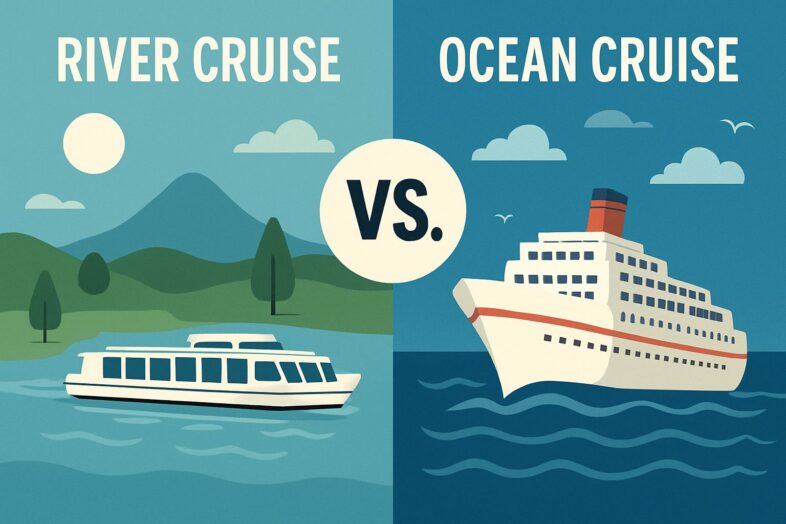
Considering a River Cruise vs. Ocean Cruise? The quick answer is that river cruises focus on destination-heavy inland waterways with small boutique ships, while ocean cruises offer massive floating resorts with diverse onboard entertainment and open-sea travel.
River Cruise vs. Ocean Cruise Article Takeaways:
- River cruises carry 100–200 passengers on average, compared to thousands on ocean ships — making them a fundamentally different travel experience in terms of intimacy and access.
- Ocean cruises cover more ground, often hitting Spain, France, Italy, and Greece in a single 12-night itinerary, while river cruises go deeper into fewer destinations.
- Summer 2027 bookings are already filling up — the best itineraries and cabin categories on both river and ocean ships tend to sell out 12–18 months in advance.
- Your travel style is the deciding factor — whether you cruise for the ship experience or the port experience will point you clearly toward one option over the other.
- One cruise type is significantly better for first-time Europe travelers — and it might not be the one you expect. The answer is covered below.
Choosing between a river cruise and an ocean cruise for Europe in summer 2027 is one of the most important decisions you’ll make before you even pack a bag.
Both options will get you to Europe. Both will show you something extraordinary. But they are not interchangeable — and picking the wrong one for your travel style can leave you feeling like you missed the point entirely. If you’re in the early stages of planning, Cruise & Travel Experts is a solid resource for comparing itineraries and getting real guidance before you commit to anything.
Which Cruise Type Is Right for Your Europe Trip?
The fastest way to answer this is to ask yourself one question: are you traveling for the ship or for the ports? If the ship is the destination — the dining, the entertainment, the pool deck at sunset — you want an ocean cruise. If the ship is just your moving hotel and every morning you want to step off into a new city, a river cruise fits that picture much better.
Everything else — price, pace, crowd size, included amenities — flows from that single distinction.
What a River Cruise Actually Looks Like in Europe
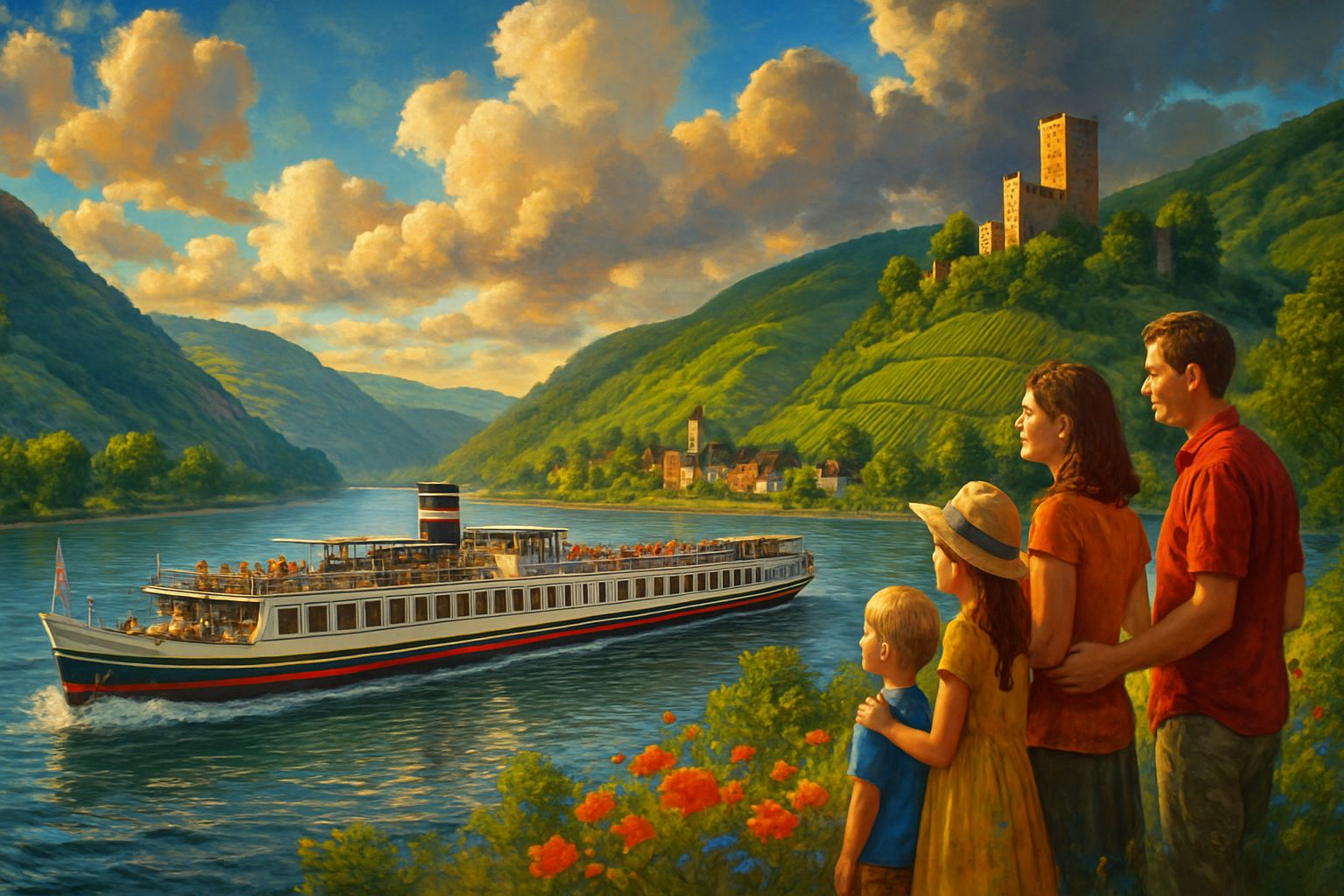
A European river cruise is nothing like what most people imagine when they hear the word “cruise.” There is no vast open ocean, no massive atrium lobby, no Broadway-style show at night. Instead, picture a long, narrow vessel — purpose-built to navigate the Rhine, Danube, Douro, or Seine — gliding quietly past medieval towns, vineyards, and castle-topped hillsides while you have dinner just meters from the riverbank.
The pace is slower, the scenery is constant, and the experience is far more immersive than an ocean voyage. Think of it less like a cruise and more like an intimate guided tour where you only have to unpack once.
Ship Size and Passenger Count
European river cruise ships typically carry between 100 and 200 passengers. Some of the smaller expedition-style vessels carry fewer than 60. Compare that to a modern ocean cruise ship from a line like Royal Caribbean or MSC, which can carry anywhere from 3,000 to over 6,000 guests. That difference in scale shapes everything — from how quickly you disembark at a port to how well the crew knows your name by day three.
Unpack Once, Wake Up Somewhere New Every Day
This is one of the most genuinely underrated advantages of river cruising in Europe. On a typical 8-night Rhine or Danube itinerary, you might wake up in Amsterdam, then Basel, then Strasbourg, then Heidelberg — without ever dragging your suitcase through an airport or hunting for a new hotel. The ship moves overnight or while you’re exploring on shore, and your cabin is exactly where you left it.
For travelers who want to cover multiple destinations without the logistical headache of moving between cities, this format is hard to beat. If you’re deciding between options, you might find this discussion on Europe river or Med cruises helpful.
Land Is Always in Sight
One of the defining characteristics of river cruising — especially for travellers who feel uneasy on open water — is that land is almost always visible. You are never far from the shore. The rivers are narrow enough that you can often watch locals cycling along the riverbank from your cabin window. This constant proximity to land makes river cruises a genuinely comfortable option for people who aren’t traditional “cruise people.”
What an Ocean Cruise Covers That a River Cruise Cannot
Ocean cruises operate on a completely different scale — geographically, socially, and in terms of onboard experience. A single Mediterranean itinerary can take you from Barcelona to Marseille, Livorno (for Florence and Pisa), Rome’s port at Civitavecchia, Naples, and Athens — all within 10 to 12 nights. That kind of geographic sweep is simply not possible on a river vessel.
Multiple Countries in One Trip
If your goal is to get a broad introduction to Europe — to sample multiple countries and decide where you want to return for a longer visit — an ocean cruise is the more efficient tool. Lines like Celebrity Cruises, Princess Cruises, and MSC Cruises offer Mediterranean summer itineraries that cover four to six countries in under two weeks. For first-time visitors to Europe who don’t yet know which region resonates most with them, this is a genuinely strategic approach.
Onboard Entertainment and Amenities
Ocean ships are floating resorts. A ship like the Norwegian Epic or the MSC Seashore offers multiple specialty restaurants, a casino, live entertainment venues, waterslides, spa facilities, and dozens of bars. River cruise ships, by contrast, offer a single dining room, a lounge, and a sun deck. Neither is better — they serve completely different purposes — but if evenings onboard matter as much to you as time ashore, the ocean ship wins this category decisively.
Popular Mediterranean Routes From Barcelona to Rome
The classic Barcelona-to-Rome routing — or its reverse — remains one of the most popular ocean cruise itineraries in the world for good reason. A typical 12-night version with a line like Princess Cruises or Celebrity Cruises will stop in Palma de Mallorca, Marseille, Genoa, Livorno, Civitavecchia (Rome), and Naples before ending in Barcelona. That’s four countries, six cities, and some of the most iconic coastline in the world — all in under two weeks.
The Real Cost Difference Between River and Ocean Cruises
Here is where many travellers get surprised: European river cruises are almost always more expensive per person than comparable ocean cruises — sometimes significantly so. A 7-night Danube river cruise with Viking River Cruises or Avalon Waterways can run anywhere from $3,000 to $6,000+ per person, depending on cabin type and season. A 7-night Mediterranean ocean cruise on MSC or Norwegian can start as low as $800 to $1,200 per person for an interior cabin.
But that comparison isn’t entirely fair without looking at what’s actually included in each price. The sticker price on a river cruise tends to cover far more than the sticker price on an ocean cruise — and that changes the real-world cost considerably.
What Is Typically Included in River Cruise Pricing
River cruise pricing is generally all-inclusive or close to it. Most lines bundle in shore excursions, alcoholic beverages with meals, gratuities, and sometimes even airfare. Viking River Cruises, for example, includes guided tours at every port as a standard part of the fare. Avalon Waterways includes unlimited beverages with dinner. This means the price you see upfront is much closer to what you’ll actually spend.
Ocean cruises, on the other hand, often present a base fare that covers your cabin and main dining — and then layer on additional costs for shore excursions, specialty restaurants, drink packages, Wi-Fi, and gratuities. It’s not uncommon for a couple on a 7-night Mediterranean ocean cruise to spend $500 to $1,500 more than the advertised base fare once all those extras are added in.
Cost Category River Cruise (e.g., Viking) Ocean Cruise (e.g., MSC, Norwegian) Base Fare (per person, 7 nights) $3,000 – $6,000+ $800 – $2,500+ Shore Excursions Usually included $50 – $200+ per port Drinks Package Often included with meals $70 – $110 per person/day (add-on) Gratuities Usually included $15 – $20 per person/day (added on) Wi-Fi Usually included $20 – $35 per day (add-on) Specialty Dining N/A (single dining room) $30 – $60 per person per meal
What Ocean Cruise Pricing Usually Looks Like
Ocean cruise lines operate on a model designed to get you onboard at a low entry price and then offer upgrades and add-ons throughout the journey. The base fare is real — you can absolutely sail a 7-night Mediterranean cruise for under $1,000 per person — but that fare covers your cabin and access to the main buffet and dining room. Everything beyond that is à la carte.
For travelers who are disciplined about spending and happy to skip the premium extras, ocean cruising remains one of the most affordable ways to see multiple European destinations in a short time. For travelers who prefer a fully covered, no-surprise experience, the river cruise all-inclusive model tends to feel more comfortable — even at the higher upfront price.
Which Cruise Suits Your Travel Style Best
At this point, the choice between river and ocean often comes down to something more personal than price or itinerary. It comes down to who you are as a traveler — how you like to move through a place, how much stimulation you want, and how important it is to feel genuinely connected to the destination rather than passing through it. For those interested in sustainable travel options, understanding the biogas production process can be a valuable consideration when choosing eco-friendly cruise lines.
Best Choice for First-Time Europe Travelers
If this is your first trip to Europe and you have no strong pull toward a particular region, an ocean cruise is the smarter starting point. The geographic coverage of a well-designed Mediterranean itinerary lets you sample Spain, France, Italy, and Greece in a single trip — and that exposure is genuinely useful for deciding where you want to go back and spend real time.
The consensus among experienced Europe travelers is consistent on this point: do the broad-stroke ocean cruise first, identify the places that move you, and then return for the deeper river cruise experience later. A river cruise through Bordeaux or along the Douro in Portugal hits very differently once you already know you love that part of the world.
Best Choice for Slow-Pace and Relaxed Travel
If your ideal travel day involves a leisurely morning coffee on a sundeck while a medieval town drifts past your window, followed by a guided walk through a market, followed by a long lunch with local wine — that’s a river cruise. The pace is deliberately unhurried, the crowds are small, and the entire structure of the trip is built around immersion rather than efficiency.
Best Choice for Travelers With Older or Less Mobile Companions
River cruises have a practical advantage here that often goes unmentioned: the gangway from ship to shore is short, flat, and simple. There are no massive terminals to navigate, no long walks from the ship to the port exit, and no tender boats required. For travelers with mobility considerations — or anyone who finds large-ship logistics exhausting — the river cruise format removes a significant amount of physical strain from the daily routine. If you’re considering your options, you might find this discussion on river vs. ocean cruises helpful.
Why Summer 2027 Timing Matters for Your Decision
Summer in Europe is spectacular and brutal in equal measure. July and August bring long golden evenings, open-air festivals, and Mediterranean waters warm enough to swim in — but they also bring record crowds, inflated prices, and temperatures that regularly exceed 35°C (95°F) in southern destinations like Rome, Athens, and Barcelona. For summer 2027 specifically, booking early is not just recommended — it’s essential. The most desirable cabin categories on Viking, Avalon, Celebrity, and Princess itineraries for July and August 2027 are already drawing interest, and the best deals are typically available 12 to 18 months out.
August Is the Most Crowded and Expensive Month in Europe
August is peak season in Europe without exception. Popular river cruise ports like Amsterdam, Strasbourg, and Budapest see their highest foot traffic of the year, and Mediterranean cruise destinations like Santorini, Dubrovnik, and Barcelona are genuinely overwhelming in mid-summer. Prices for both river and ocean cruises are at their annual high point in July and August, and availability on preferred itineraries tightens fast. If you have flexibility in your 2027 travel window, even shifting your departure by two to three weeks in either direction can make a noticeable difference in both cost and experience quality.
How to Pick the Best Summer Window for Either Cruise Type
For ocean cruises in the Mediterranean, late May through mid-June and mid-September through early October offer the most favorable conditions — warm weather, lower prices, and meaningfully thinner crowds at port destinations. For European river cruises, the same logic applies: June and early September tend to offer better value than peak July and August sailings, and the weather along the Rhine and Danube corridors is still excellent during those shoulder windows.
If summer 2027 is your fixed window, here is how to approach the timing strategically:
- Early June departures offer the best balance of warm weather and manageable crowds for both cruise types
- Mid-July to mid-August is peak pricing — book 14 to 18 months in advance if this is your only window
- Late August into September sees prices begin to ease while temperatures remain comfortable, especially in northern Europe river cruise destinations
- River cruise water levels can fluctuate in summer due to drought conditions — a real operational consideration that affected multiple sailings on the Rhine in recent years
- Mediterranean ocean cruise ports like Dubrovnik and Santorini implement visitor caps during peak summer, which can affect shore excursion availability
River Cruise or Ocean Cruise: Here Is the Final Verdict
If you want breadth — multiple countries, iconic coastlines, onboard entertainment, and a lower entry price — book a Mediterranean ocean cruise for summer 2027. Lines like Celebrity Cruises, Princess Cruises, and MSC Cruises offer well-designed itineraries that cover more of Europe in 10 to 12 nights than most independent travelers could manage in a month. It is the smarter first move for anyone new to European travel.
If you want depth — genuine immersion in a region, intimate ship culture, all-inclusive pricing, and the singular pleasure of waking up in a new riverside city every morning — a European river cruise is worth every extra dollar. Viking River Cruises and Avalon Waterways consistently lead the category for good reason. The river cruise experience is not better or worse than ocean cruising. It is simply a different kind of travel, built for a different kind of traveller. Know which one you are, book early for 2027, and the rest tends to take care of itself.
Frequently Asked Questions
Still deciding? These are the questions travellers ask most often when comparing river and ocean cruise options for Europe.
Is a river cruise or ocean cruise better for a first trip to Europe?
For most first-time visitors to Europe, an ocean cruise is the better starting point. A well-planned Mediterranean itinerary gives you exposure to multiple countries and regions in a single trip, which helps you figure out where you actually want to spend more time on future visits.
That said, if you already know which part of Europe calls to you — if you have a deep pull toward France, Germany, or the Danube corridor — a river cruise is not a wrong choice at all. The deciding factors usually come down to a few key considerations, such as whether you want to explore the unique cultural aspects of each region.
- How much of Europe do you want to cover in one trip?
- Do you prefer the ship experience or the port experience?
- Is an all-inclusive pricing structure important to you?
- Are you comfortable on open water, or does staying close to shore matter?
- Are you traveling with older companions or anyone with mobility considerations?
Answer those honestly and the right choice becomes clear relatively quickly.
Are excursions included in European river cruise prices?
On most major river cruise lines — including Viking River Cruises, Avalon Waterways, and AmaWaterways — guided shore excursions are included in the base fare as a standard feature. This is one of the most meaningful practical differences between river and ocean cruise pricing. On ocean cruises, shore excursions are almost always an additional cost, typically ranging from $50 to $200 or more per person per port. For those interested in learning more about the innovations in travel technology that may impact future cruise experiences, further reading is available.
How many passengers are typically on a European river cruise vs. an ocean cruise?
A standard European river cruise ship carries between 100 and 200 passengers. Some boutique vessels carry fewer than 60. Ocean cruise ships at the mainstream end of the market — Royal Caribbean, MSC, Norwegian — typically carry between 3,000 and 6,500 passengers. That difference in scale affects everything from how quickly you get off the ship at each port to how personalized the service feels throughout the voyage. For those interested in comparing different options, this scale difference is crucial.
Is summer 2027 a good time to book a European cruise?
Summer 2027 is an excellent time to cruise Europe — but timing your booking and your departure window carefully makes a significant difference. Here is what to keep in mind:
- Book now if you haven’t already — premium cabins on top-rated itineraries for July and August 2027 will not last
- June and early September offer the best value within the broader summer window
- Peak July and August sailings carry the highest fares and the most crowded port experiences
- River cruise water levels in summer can be unpredictable — ask your cruise line about their low-water contingency policies before booking
Summer in Europe rewards travelers who plan ahead. The destinations are genuinely spectacular in the warmer months — long daylight hours, outdoor dining, festivals, and warm Mediterranean waters are all part of the package.
The key is not to let the peak-season crowds and prices catch you off guard. Build your expectations around the reality of summer travel in Europe and the experience consistently delivers.
Can you visit multiple countries on a European river cruise?
Yes — but the multi-country experience looks different on a river cruise than it does on an ocean cruise. Many of the most popular European river itineraries do cross international borders. A classic 8-night Danube cruise, for example, might pass through Germany, Austria, Slovakia, and Hungary — stopping in Regensburg, Passau, Vienna, Bratislava, and Budapest along the way.
However, river cruise itineraries are geographically constrained by the river itself. The Rhine flows through Switzerland, Germany, France, and the Netherlands. The Danube crosses Central and Eastern Europe. The Douro winds through Portugal and into Spain. You will visit multiple countries, but they will all be within a single connected corridor rather than spread across the broader continent.
Ocean cruises offer a wider geographic spread in a single itinerary — mixing Western Mediterranean with Adriatic ports, or combining the Canary Islands with mainland Spain and Morocco. If maximum geographic diversity across Europe is the goal, the ocean cruise format delivers that more efficiently. If depth within a specific European corridor matters more to you, the river cruise version of multi-country travel is genuinely rewarding in a way that no ocean itinerary can fully replicate.
Ready to start comparing real itineraries for summer 2027? Cruise & Travel Experts helps travelers navigate both river and ocean cruise options across Europe — so you find the right fit before the best cabins are gone.