
When the top of your bum crack is sore and itchy, everyday activities can become surprisingly difficult. Driving, cycling, exercising and even sleeping may appear to trigger the problem, leaving you unsure whether to change your chair, bicycle saddle, clothing, mattress or exercise routine.
The natural assumption is that these are four separate activities causing four separate problems. But a more useful question is:
What physical condition are all these activities recreating around the painful or itchy area?
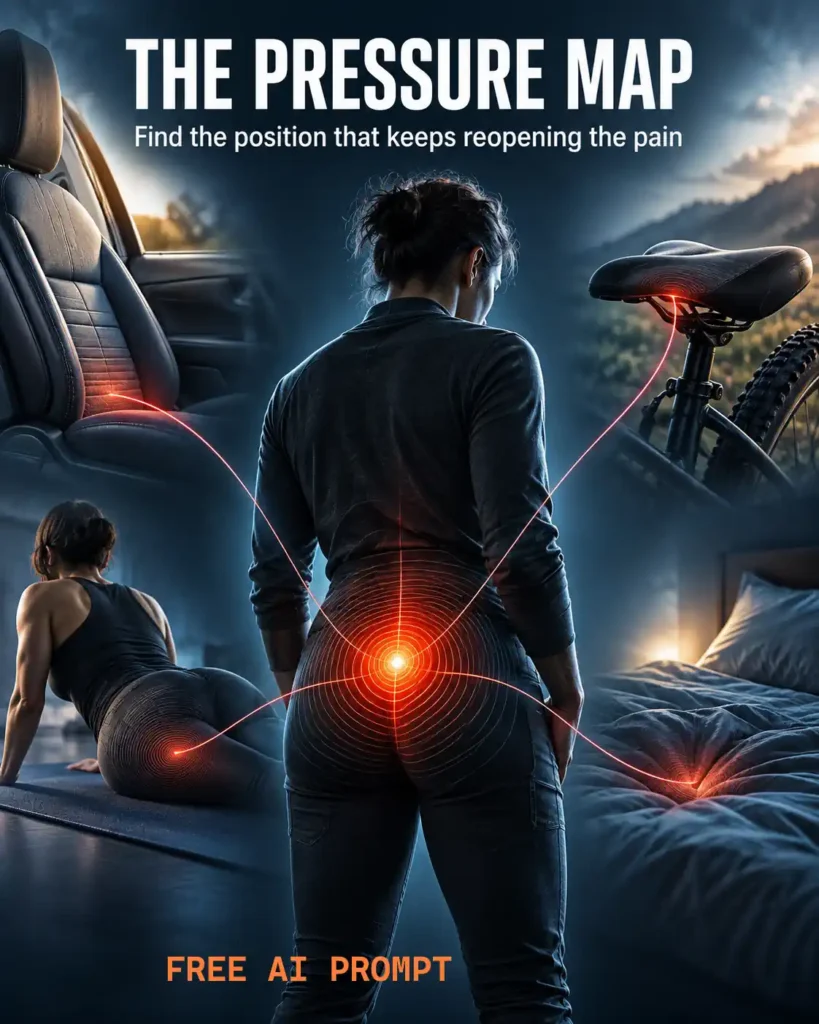
Driving, cycling, exercising and sleeping can expose the same small area to different combinations of pressure, friction, heat and moisture. The activity changes, but the irritated spot and the forces acting upon it may remain remarkably similar.
This is where a pressure map becomes useful. You are not simply recording when it hurts. You are working out where the discomfort begins, what builds before it begins and which change reduces it.
A pressure map cannot diagnose the cause. It can, however, reveal a repeatable trigger, help you make more sensible adjustments and give a doctor or other healthcare professional much more useful information if the problem needs assessment.
Do not map the activity. Map the load it places on the sore area.
Why “Sitting Causes It” Is Not a Complete Explanation
People often describe this type of discomfort simply as pressure from sitting. In reality, there are at least four different forces that may be contributing: pressure, friction, heat and moisture.
These forces can occur separately, but they often overlap. Understanding which one dominates gives you a better basis for deciding what to change.
1. Pressure builds on one small area
Pressure is sustained loading on a particular spot. It may build while you sit in a car, rest against the back of a chair, lie on your back or place your weight on a bicycle saddle.
One important clue is delayed pain that begins after a reasonably consistent amount of time. For example, you may feel comfortable when you first get into the car but notice soreness after approximately 20 minutes.
That delay suggests that the problem may not be the simple act of sitting down. It may be the accumulation of load in one position.
2. Friction comes from repeated movement
Friction is rubbing between opposing skin surfaces or between the skin, clothing and equipment. It may become more noticeable while cycling, running, rowing, bending repeatedly or exercising in clothes with a badly positioned seam.
Friction-related discomfort may appear during repeated movement even when sitting still is relatively comfortable. A person may therefore tolerate a dining chair but experience soreness and itching while pedalling a bicycle.
This is an important distinction because adding more padding does not necessarily reduce rubbing. In some situations, it may create a warmer, tighter or less stable contact area.
3. Heat can lower the area’s tolerance
Heat can make an already sensitive area less tolerant of pressure and friction. Heated car seats, warm bedding, close-fitting synthetic clothing and indoor cycling can all trap heat around the top of the buttock cleft.
The activity may seem to be the trigger, but the more revealing clue may be that the discomfort is worse in warm conditions or after the area has been covered for a prolonged period.
4. Moisture amplifies rubbing and irritation
Moisture may come from perspiration during exercise, warm weather, non-breathable clothing or several hours beneath warm bedding.
Moist skin may be more vulnerable to irritation from rubbing. This helps explain why a bicycle ride or workout can cause symptoms more quickly on a hot day, even when the equipment and activity remain unchanged.
A cyclist may experience saddle pressure, repeated movement, heat and perspiration simultaneously. A driver may experience sustained pressure followed by friction as they repeatedly shift position. Someone sleeping on their back may load the same sensitive area for hours while warm bedding traps heat and moisture.
If you call every trigger “sitting”, you miss these differences. If you separate pressure, friction, heat and moisture, the pattern becomes easier to test.
How to Build Your Pressure Map
A useful pressure map records five things:
- The exact location
- The time taken for symptoms to begin
- Your body position
- The contact conditions
- The after-effect
Identify the exact location
The phrase “bum crack pain” can refer to several different areas. The discomfort may be within the skin fold, at the very top of the cleft, over the tailbone or closer to one buttock.
Do not repeatedly press, squeeze or aggressively inspect a painful area. Simply describe the location as precisely as you can. Note whether the main symptom feels like surface itching, skin soreness, deeper pain or tenderness around a lump or swollen area.
This distinction matters because discomfort that feels as though it is on the skin may behave differently from deeper pain produced by sitting or leaning backwards.
Measure the time to onset
Ask how long the activity remains comfortable.
Does the pain begin as soon as you sit down, or after 20 minutes? Does cycling feel comfortable for the first few miles? Do you wake during the night, or notice the soreness only when getting out of bed?
Time to onset is a clue about accumulation. Immediate discomfort may behave differently from discomfort that appears only after pressure, rubbing, heat or moisture has gradually built up.
Record the position, not merely the activity
“Driving” is not one fixed position. You might be sitting upright, slouching, reclining the backrest or rolling your pelvis backwards. You might also shift onto one buttock when the discomfort begins.
Likewise, “cycling” could mean riding upright on a wide saddle or leaning forward on a narrower one. “Exercise” might involve running, repeatedly bending, sitting on gym equipment or lying on a mat.
When sleeping, record whether symptoms are associated with lying on your back, side or front. The goal is to identify the position that loads or rubs the affected area, not simply to blame the entire activity.
Note the contact conditions
Record the firmness and shape of the seat, saddle or mattress. Check for prominent clothing seams, tight underwear, non-breathable fabrics, damp exercise clothes and cushions that allow you to sink deeply.
Softness alone does not tell you whether something is helping. A soft cushion might initially feel comfortable but increase heat or contact around the irritated area.
Comfort in the first five minutes is not the same as better pressure distribution.
Check what happens afterwards
Do symptoms settle within minutes of changing position? Does the area remain sore for the rest of the day? Is the itching worse after removing damp clothing? Does the pain become more noticeable the following morning?
An adjustment that delays discomfort during the activity but produces a stronger reaction later may not be a genuine improvement.
Judge the change by the whole response during and after the activity, not simply by how comfortable it feels at first.
A Practical Example: When Driving and Cycling Seem to Cause the Same Pain
Imagine someone who reports that both driving and cycling cause pain at the top of the bum crack.
When they create a pressure map, they notice that cycling discomfort begins after approximately 15 minutes. It is accompanied by perspiration and a surface rubbing sensation. Driving pain begins after 25 minutes, but mainly when the seat is reclined and the pelvis has rolled backwards.
Sleeping on the side is comfortable. Lying flat on the back recreates the deeper discomfort experienced while driving.
The map now suggests two related but distinct patterns:
- Cycling combines friction, moisture and saddle contact.
- Driving and back-sleeping share prolonged rearward loading.
Treating everything as a general inability to sit would conceal those differences. The person might buy a new saddle, a car cushion and a mattress topper without learning which condition actually matters.
The better approach is to change one mapped variable at a time.
Use three controlled comparisons
Same activity, different position
Keep the journey length broadly similar but make the car seat slightly more upright. Does this alter where the pressure falls or delay the onset of discomfort?
Same position, different duration
Test whether a short bicycle ride is tolerated when a longer ride causes a flare. This helps reveal whether the problem is associated with accumulated exposure.
Same duration, different contact condition
Keep the activity and duration similar but change one contact factor, such as removing a bulky seam or promptly changing out of damp exercise clothing.
Avoid changing the saddle, shorts, car-seat position, cushion, mattress and workout simultaneously. If the pain improves, you will not know which change helped. If it worsens, you will not know which change caused the problem.
One change creates information. Five changes create confusion.
When a Pressure Map Is Not Enough
Pain, soreness or itching at the top of the buttock cleft can have different causes. Not all of them should be managed by experimenting with positions, clothing or cushions.
Seek medical advice if the problem persists, repeatedly returns, becomes more painful or cannot be explained by a temporary irritation.
A painful lump, swelling, redness, bleeding, pus or other discharge, an unpleasant smell, fever or feeling generally unwell should not be treated as a seating problem. These symptoms may need prompt assessment. A painful lump at the top of the buttock cleft that is bleeding or leaking pus can be associated with an infected pilonidal sinus.
Pain following an injury, unexplained numbness or weakness, or changes in bladder or bowel control also require medical attention. If you are uncertain about the urgency of your symptoms, contact an appropriate healthcare professional or NHS 111.
Until the cause is clearer, do not use activity testing as a reason to push through worsening symptoms. The pressure map is a tool for recognising patterns and communicating them clearly. It is not proof that the condition is harmless.
The Final Pressure-Mapping Rule
Before buying more equipment or abandoning driving, cycling, exercise or your normal sleeping position, record:
- The exact spot affected
- How long symptoms take to begin
- Your body position at the time
- Whether pressure, friction, heat or moisture dominates
- How the area responds later that day and the following morning
Then change one variable and see whether the pattern changes.
The position that triggers soreness gives you useful information. The position that does not trigger it is equally valuable because it reveals what the area can currently tolerate.
Do not simply ask, “Which activity hurts?” Ask, “What load does this activity recreate, and what happens when I remove that load?”
That question is the practical starting point for returning to driving, cycling, exercising and sleeping without repeatedly provoking the same painful or itchy area.
Try This With AI
Use the AI you’re already using: ChatGPT, Claude, Gemini, Grok, Meta AI, Copilot, or another general-purpose AI assistant. Replace the example information inside the brackets with your own information, then copy and paste the complete prompt into your AI.
AI Prompt
Help me create a practical pressure map from this description of my bum crack pain, soreness, or itching: [Example: It feels sore near the top of the cleft after about 20 minutes in a reclined car seat, worsens after 15 minutes of cycling when I’m hot and sweaty, and sometimes hurts after sleeping on my back. Side-sleeping and short walks are comfortable. I haven’t noticed a lump, bleeding, discharge, fever, numbness, weakness, or bladder or bowel changes.] Do not diagnose the condition or present guesses as medical facts. First, extract the exact location, time to onset, body position, contact conditions, after-effect, and any relevant missing observations. Then distinguish which activities appear to involve pressure, friction, heat, or moisture, clearly labelling uncertain conclusions as inferences. Identify patterns shared across activities, especially any position or load that may be repeatedly provoking the same area. Recommend three cautious one-variable comparisons I could use to gather better information without pushing through worsening symptoms, stating what must remain unchanged, what single variable to alter, and what response to record during the activity, later that day, and the next morning. Finish with a compact tracking table I can reuse and a clearly separated safety section identifying details in my description that suggest I should stop experimenting and seek medical advice, including persistent or worsening symptoms, a painful lump, swelling, redness, bleeding, discharge, unpleasant smell, fever, feeling unwell, pain after injury, numbness, weakness, or bladder or bowel changes.