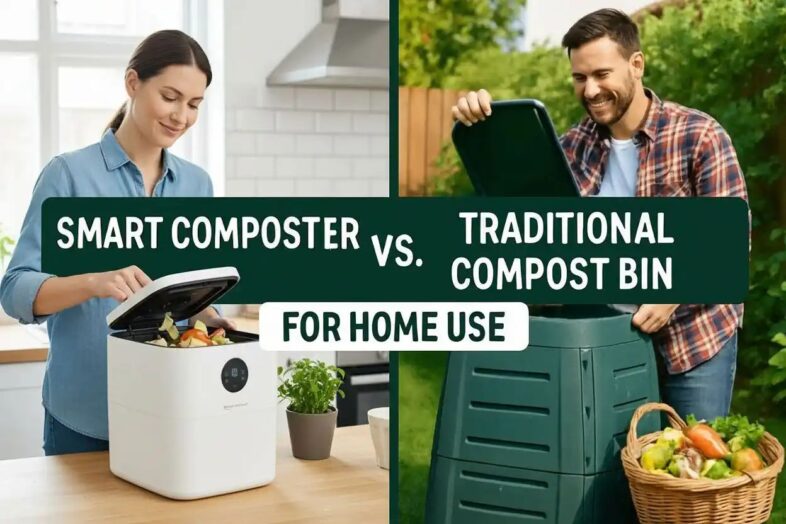
In this article, we debate the pros and cons of smart composters vs traditional compost bins, and there is no simple answer, but hopefully after reading this, you’ll be well able to make an informed decision.
Important Points to Remember:
- Smart composters process food scraps in as little as 3–5 hours, while traditional compost bins can take anywhere from 2 months to over a year to produce usable compost.
- The output from most electric composters is not true compost — it’s a dehydrated, pre-composted material that still needs to break down further before your garden can fully benefit from it.
- Traditional composting wins on environmental impact when done correctly, producing richer, microbe-dense compost with zero electricity consumption.
- Your living situation matters more than you think — apartment dwellers and small-space homeowners will find smart composters far more practical, while homeowners with outdoor space get more long-term value from traditional bins.
- Cost, maintenance, and what you actually compost are the three deciding factors most people overlook — and we break all three down in detail below.
Most People Choose the Wrong Composting Method — Here’s How to Get It Right
Picking the wrong composting method wastes money, kills enthusiasm, and sometimes ends with a smelly bin shoved in the corner of your kitchen never to be touched again.
The smart composter market has exploded in recent years, with devices like the Lomi by Pela, the Mill Kitchen Ecosystem, and the Vitamix FoodCycler FC-50 promising to turn last night’s dinner scraps into garden-ready material overnight. At the same time, traditional backyard composting has been quietly doing the same job — for free — for centuries. One Clear Drop is one resource helping homeowners cut through the noise and make smarter, more sustainable choices about how they handle organic waste at home.
The truth is, neither method is universally better. The right choice depends on your space, budget, lifestyle, and what you actually plan to do with the end product. This breakdown covers everything you need to make that call confidently.
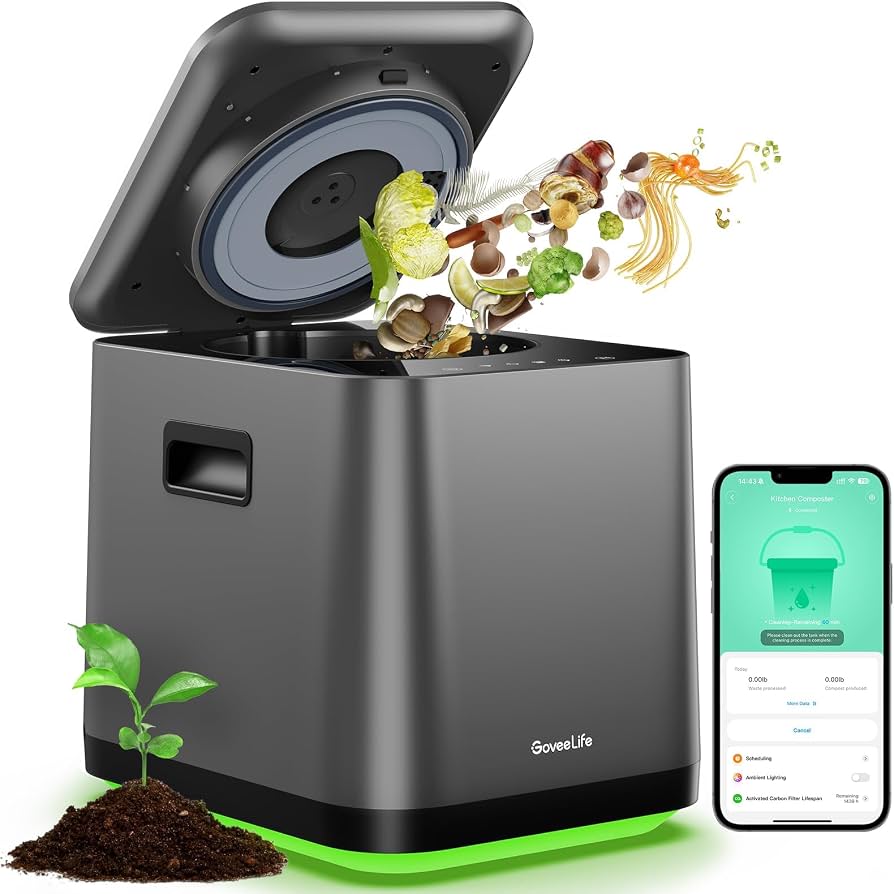
“GoveeLife Smart Electric Composter for Kitchen, 3L Compost Bin Indoor with App & Voice Control, Auto-Cleaning, 3 Modes, Turn Food Waste to Fertilizer for Garden, Food Waste Compost Machine : Amazon.co.uk: Garden” from www.amazon.co.uk and used with no modifications.
What Smart Composters Actually Do
Smart composters — also called electric composters or food cyclers — are countertop or under-counter appliances that rapidly reduce food waste volume using heat, grinding, and dehydration. They are not composters in the traditional biological sense. Instead, they mechanically process food scraps into a dry, reduced material much faster than nature would.
For those interested in the technical side, you might want to explore how depackaging machines aid in food and organic waste separation.
How Electric Composters Break Down Food Scraps
Most electric composters follow a three-stage process: grinding, heating, and dehydrating. The Lomi by Pela, for example, heats food scraps to temperatures between 50–75°C while simultaneously grinding and aerating the material. This drives out moisture and reduces the volume of scraps by up to 90%. The entire cycle runs between 3 and 5 hours depending on the mode selected.
Some higher-end units, like the Mill Kitchen Ecosystem, add a subscription-based pickup service where the dried material is collected and sent to farms — bypassing the need for users to manage the output themselves. Others, like the Vitamix FoodCycler FC-50, simply produce a dry, odor-reduced material you add to your outdoor bin or garden beds directly.
What Comes Out of a Smart Composter
This is where most marketing gets misleading. The output from an electric composter is not finished compost. It lacks the microbial activity that defines true compost — the living ecosystem of bacteria, fungi, and microorganisms that make decomposed organic matter so valuable to soil. What you get is closer to a dehydrated food byproduct that still needs weeks of outdoor decomposition before it becomes plant-ready. Environmental experts and soil scientists consistently flag this distinction, and it matters if you’re composting specifically to enrich garden soil. For those interested in the technicalities of waste separation, depackaging machines offer insights into the process.
Which Food Scraps Smart Composters Accept
One area where smart composters genuinely pull ahead is input flexibility. Traditional composting has a strict no-go list. Smart composters are significantly more permissive, offering innovative food waste processing solutions.
Most electric composters accept:
- Fruit and vegetable scraps
- Cooked foods and leftovers
- Meat and fish (in most units)
- Dairy products
- Small bones (unit-dependent)
- Coffee grounds and paper filters
- Eggshells
The ability to process meat and dairy is a significant advantage. These materials attract pests and create serious odor problems in traditional outdoor setups, which is why most composting guides explicitly ban them. For households that generate a lot of protein-based food waste, this alone can make an electric composter the more practical everyday solution.

“Home composting – Wikipedia” from en.wikipedia.org and used with no modifications.
How Traditional Compost Bins Work
Traditional composting is biological decomposition — microorganisms, worms, and fungi breaking down organic material into humus, the dark, crumbly, nutrient-dense matter that gardeners call black gold. The process requires the right balance of nitrogen-rich “greens” (food scraps, grass clippings) and carbon-rich “browns” (dried leaves, cardboard), adequate moisture, and regular aeration to keep oxygen flowing to the microbial community doing the work.
Done right, traditional composting produces a genuinely superior soil amendment. The finished product is teeming with beneficial microorganisms, improves soil structure, boosts water retention, and feeds plants slowly and steadily over time. It also costs virtually nothing to run once you have your bin set up.
The Three Main Types: Bins, Tumblers, and Open Piles
Traditional composting isn’t one-size-fits-all either. There are three primary setups, each with different trade-offs in speed, effort, and pest control.
Stationary bins like the FCMP Outdoor IM4000 or a basic plastic Maze compost bin are the most common entry point. They’re affordable, hold a large volume, and require minimal setup — but they decompose slowly (6–12 months) and need manual turning with a pitchfork or aerator tool to speed things up.
Compost tumblers, such as the FCMP Outdoor IM4000 Dual Chamber Tumbler, speed up decomposition by making aeration easier — you simply rotate the drum every few days. Well-managed tumblers can produce finished compost in as little as 4–8 weeks. They’re also better at deterring rodents since the material is fully enclosed.
Open pile composting is the most low-effort approach — essentially a designated corner of your yard where organic material accumulates and breaks down over time. It’s the slowest method (up to 2 years for cold composting) but requires zero investment and can handle large volumes of yard waste.
What You Can and Cannot Compost Traditionally
Traditional composting thrives on plant-based materials:
- Fruit and vegetable scraps,
- coffee grounds,
- tea bags,
- eggshells,
- grass clippings,
- fallen leaves,
- cardboard, and
- paper are all excellent inputs.
What you should avoid putting in a traditional bin includes:
- meat,
- fish,
- dairy,
- oily foods, and pet waste
— all of which attract pests, create foul odors, and can introduce harmful pathogens into the finished compost.
Smart Composters vs. Traditional Bins: A Direct Comparison
Side by side, the differences between these two approaches are stark. Speed, cost, space, maintenance, and output quality all tell a different story depending on which method you use.
Speed: Hours vs. Months
Speed is where electric composters win without contest. A Lomi by Pela completes a full cycle in 3–5 hours. The Vitamix FoodCycler FC-50 runs a similar timeline. Traditional composting in a stationary bin? You’re looking at 6–12 months minimum for cold composting, or 4–8 weeks in a well-managed tumbler with consistent turning and the right green-to-brown ratio.
For most households, that speed gap is the single most compelling reason to consider an electric unit. If you’re generating food scraps daily and don’t have months to wait for an output you can actually use, the math makes sense. But speed doesn’t equal quality — and the faster process comes with real trade-offs in what the end product can actually do for your soil.
Space Requirements for Each Method
A countertop electric composter like the Lomi takes up roughly the same space as a large bread machine — about 16 x 13 inches of counter space. Some users keep them under the sink or in a pantry cupboard. For apartment dwellers or anyone without outdoor space, this is a game-changer. There’s no yard required, no weatherproofing needed, and no neighbors to upset with a backyard pile.
Traditional composting demands outdoor real estate. Even a compact tumbler like the FCMP Outdoor IM4000 Dual Chamber requires a dedicated spot in your garden or yard, ideally with partial sun exposure to maintain internal temperatures. Open pile composting needs even more room. If you’re working with a balcony or a small patio, traditional methods become genuinely impractical without creative solutions like worm bins (vermicomposting), which are a separate category entirely.
Cost Differences: Upfront and Long-Term
The cost gap between these two approaches is significant. A quality electric composter ranges from $300 to $700 USD upfront — the Lomi retails around $499, while the Vitamix FoodCycler FC-50 sits closer to $350. Add ongoing electricity costs (typically $0.10–$0.25 per cycle depending on your energy rate) and replacement carbon filters every few months, and the annual operating cost adds up. Traditional compost bins, by contrast, range from completely free (an open pile costs nothing) to around $80–$150 for a quality tumbler like the Envirocycle Mini Tumbling Composter. After that initial spend, traditional composting is essentially free to run indefinitely.
Maintenance Demands of Each Method
Maintenance looks very different depending on which path you choose. Electric composters are largely push-button — load the bucket, press start, empty the output. The main recurring tasks are cleaning the grinding bucket and replacing the activated carbon filters that control odor. Traditional composting requires more hands-on involvement, particularly if you want results faster than a year.
- Electric composters: Clean the bucket after each cycle, replace carbon filters every 3–4 months, occasionally descale the heating element
- Stationary bins: Turn the pile every 1–2 weeks, monitor moisture levels, balance greens and browns as you add new material
- Compost tumblers: Rotate the drum every 2–3 days, check moisture, add browns if the pile gets too wet or compacted
- Open piles: Minimal intervention needed, though decomposition slows significantly without turning
For people with busy schedules, the low-touch nature of an electric composter is a genuine lifestyle fit. But “low maintenance” doesn’t mean zero attention — a neglected electric composter with a dirty bucket or a clogged filter will develop odors quickly.
Traditional composting rewards consistency. The more regularly you turn and monitor your pile, the faster and better the results. Think of it less like a chore and more like tending a living system — because that’s exactly what it is.
Neither method is truly maintenance-free. The difference is the type of maintenance: mechanical upkeep for electric units versus biological management for traditional bins. Choose based on which kind of hands-on work you’re actually willing to do long-term.
Which Produces Better Compost for Your Garden
Traditional composting produces genuinely superior finished compost — full stop. Mature compost from a well-managed bin or tumbler is rich in beneficial microorganisms, improves soil aeration and water retention, and provides a slow-release nutrient profile that synthetic fertilizers can’t replicate. The biological activity in finished compost is what makes it so valuable — it feeds the soil food web, not just the plant.
The output from an electric composter, while useful as a soil additive when further composted outdoors, doesn’t carry that same biological richness straight out of the machine. It’s a starting point, not a finished product. If your primary goal is producing high-quality compost for a vegetable garden, a flower bed, or a lawn, a traditional bin or tumbler will consistently outperform any electric unit currently on the market.
Are Smart Composters Actually Eco-Friendly?
This is the question the marketing materials don’t answer clearly. Electric composters do reduce the volume of food waste going to landfill — which is genuinely positive, since organic matter in landfills produces methane, a greenhouse gas significantly more potent than CO₂ over a 20-year period. But the eco-friendliness of any electric appliance depends heavily on what happens during operation and what happens to the output afterward.
Energy Consumption of Electric Composters
Electric composters are energy-intensive appliances. The Lomi by Pela draws approximately 1 kilowatt-hour (kWh) per cycle on its standard Lomi Approved mode, and slightly more on the Grow mode cycle. Running a daily cycle for a year adds up to roughly 365 kWh annually — comparable to running a mid-sized window air conditioner for several weeks straight.
Whether that energy use is justified depends largely on your local electricity grid. If your home runs on renewable energy — solar panels, a green energy plan, or a grid with high renewable penetration — the carbon cost of running an electric composter drops considerably. If you’re on a coal-heavy grid, the carbon footprint of daily electric composting begins to compete with the methane emissions you’re avoiding by keeping scraps out of landfill.
The honest answer is that the environmental math on electric composters is not as clean as the product packaging suggests. For genuinely low-impact food waste management, traditional composting remains the more ecologically sound choice in most situations. That said, electric composters still represent a meaningful upgrade over throwing food scraps in the trash — especially for urban households with no alternative.
Carbon Footprint: Electric vs. Natural Decomposition
Natural decomposition in a well-aerated compost bin is essentially carbon-neutral. The CO₂ released during aerobic decomposition is part of the natural carbon cycle — the same carbon the plants absorbed while growing. Managed correctly, traditional composting produces minimal methane (which is only generated in anaerobic, oxygen-deprived conditions like landfills or a waterlogged pile). For those looking to explore setting up a food waste processing facility, understanding the carbon footprint of composting methods is essential.
Electric composters interrupt this natural cycle with an energy-powered mechanical process, adding a carbon cost that doesn’t exist in traditional composting. The net benefit still exists compared to landfill disposal, but it’s smaller than manufacturers typically imply. Key factors that influence the real carbon footprint of an electric composter include:
- Your local electricity grid’s energy mix (coal vs. renewable)
- How frequently you run cycles
- Whether the output is further composted outdoors or simply discarded
- The energy used in manufacturing the appliance itself (embodied carbon)
If sustainability is your primary motivation for composting — not just convenience — traditional composting is the lower-impact choice in nearly every measurable category.

“Compost – Wikipedia” from en.wikipedia.org and used with no modifications.
Which Composting Method Fits Your Home
The right composting method isn’t about which one is objectively better — it’s about which one you’ll actually stick with. A neglected traditional bin that becomes a pest magnet is worse for the environment than a consistently used electric composter. Consistency beats perfection every time when it comes to building sustainable home habits.
Your living situation, outdoor access, weekly food waste volume, and tolerance for maintenance are the four variables that should drive your decision. Below is a clear breakdown of which setup makes the most sense depending on your circumstances.
Best Option for Apartment and Small-Space Living
If you’re working with a kitchen, a balcony, or a small urban apartment, an electric composter is the only realistic countertop composting option. Units like the Lomi by Pela or the Vitamix FoodCycler FC-50 sit neatly on a counter or inside a cabinet, process scraps overnight, and produce a dry, odor-contained output that you can bag up and drop into a green bin, mix into a potted plant, or take to a community garden. No outdoor space required. No pest concerns. No neighbors complaining about smells.
The bigger win for apartment dwellers is the meat and dairy acceptance. City kitchens generate cooked food waste constantly — leftover pasta, chicken bones, cheese rinds — none of which have any place in a traditional compost setup. An electric composter handles all of it in one cycle, which means more of your food waste actually gets diverted from landfill instead of going in the trash by default because it doesn’t fit the composting rules.
Best Option for Homeowners With Outdoor Space
If you have a backyard, a side yard, or even a generous garden patch, a traditional compost bin or tumbler is almost always the better long-term investment. The FCMP Outdoor IM4000 Dual Chamber Tumbler, for example, lets you continuously add fresh material to one chamber while the other finishes decomposing — meaning you get a near-continuous supply of finished compost without ever waiting for a full batch to complete. Paired with a small kitchen collection caddy to gather scraps before taking them outside, the workflow is simple, and the output is genuinely valuable for your soil. Over years of use, the quality of a well-managed garden that receives regular finished compost is hard to overstate — improved structure, better drainage, richer biodiversity, and healthier plants without synthetic fertiliser inputs.
The Verdict: Smart Composter or Traditional Bin
Smart composters are the right tool for urban households, renters, and anyone who generates food waste they genuinely cannot manage any other way — they reduce landfill contributions, handle inputs traditional bins can’t, and fit seamlessly into a busy lifestyle. Traditional composting wins on output quality, environmental impact, long-term cost, and soil value — making it the superior choice for anyone with outdoor space and a willingness to engage with the process. If you have the space, start with a tumbler. If you don’t, a quality electric composter beats throwing scraps in the trash every single time. The best composting method is ultimately the one you’ll actually use consistently.

“Compost – Wikipedia” from en.wikipedia.org and used with no modifications.
Frequently Asked Questions
These are the most common questions people have when choosing between an electric composter and a traditional bin — answered directly so you can move forward with confidence.
Can You Use the Output From a Smart Composter Directly in Your Garden?
Technically yes, but with important caveats. The dry, ground material that comes out of a Lomi or Vitamix FoodCycler is not finished compost — it’s a pre-composted, dehydrated food byproduct. Applied directly and in large quantities, it can actually harm plants by drawing nitrogen out of the soil as it continues to break down. To use it safely and effectively in your garden, follow these steps:
- Mix the output into your outdoor compost bin and let it finish decomposing for 2–4 weeks before applying to beds
- If applying directly to soil, use small amounts — no more than a thin layer worked into the top few inches
- Avoid placing it directly against plant stems or roots before it has fully broken down
- The Lomi Grow mode, which runs a longer, lower-heat cycle, produces an output slightly closer to usable compost than the standard mode
Some manufacturers recommend mixing the output at a ratio of roughly 1 part electric composter material to 10 parts soil for direct application. This dilution reduces the risk of nitrogen draw-down while still adding organic matter to your beds.
The safest and most effective approach is to treat the output as a compost accelerant rather than finished compost — add it to a traditional outdoor pile and let biology finish the job the machine started.
How Much Does It Cost to Run a Smart Composter Daily?
Running a Lomi by Pela on its standard mode consumes approximately 1 kWh per cycle. At the average U.S. residential electricity rate of around $0.16 per kWh (as of 2024), that works out to roughly $0.16 per day, or approximately $58 per year in electricity alone. The Vitamix FoodCycler FC-50 is slightly more energy-efficient, consuming around 0.8 kWh per cycle under similar conditions.
Factor in replacement carbon filters — typically $15–$30 for a pack every 3–4 months — and annual operating costs land between $100 and $160 per year depending on your unit and local electricity rates. That’s on top of the upfront appliance cost of $350–$500. Over a five-year lifespan, an electric composter can cost $800–$1,300 all-in. A quality compost tumbler bought once for $100–$150 costs virtually nothing beyond that.
Do Traditional Compost Bins Work in Cold Climates?
Yes, but microbial activity slows significantly in cold temperatures. Below 10°C (50°F), the bacteria responsible for decomposition begin to slow down. Below freezing, composting essentially pauses. This doesn’t mean your pile is ruined — it just means it goes dormant and picks back up in spring when temperatures rise again. Many experienced composters in cold climates keep adding material through winter, knowing it will all break down once conditions warm.
To maintain some composting activity through colder months, place your bin in a sunny, sheltered location to retain heat, insulate the sides with straw bales or bubble wrap, and increase the ratio of nitrogen-rich greens to help generate internal heat. Insulated compost bins like the Hotbin Composter are specifically designed for cold climates and can maintain internal temperatures of 40–60°C even when outdoor temperatures drop below freezing — producing finished compost year-round regardless of season.
Can You Compost Meat and Dairy in a Smart Composter?
Most electric composters — including the Lomi by Pela, Vitamix FoodCycler FC-50, and similar units — are specifically designed to handle meat, fish, dairy, and cooked foods that are off-limits in traditional composting setups.
This is one of their most practical advantages for everyday household use. The heat and dehydration process neutralizes odors and reduces pathogens in the material, making it safe to handle and store without the pest and smell issues that these inputs would cause in an outdoor bin. Always check your specific model’s guidelines, as some units have limitations on hard bones or very high-fat inputs that can clog the grinding mechanism over time.
How Long Before a Traditional Compost Bin Produces Usable Compost?
Timeline varies significantly depending on the composting method you use:
- Open pile (cold composting): 12 months to 2 years with minimal turning
- Stationary bin (cold composting): 6–12 months with occasional turning
- Compost tumbler (hot composting): 4–8 weeks with regular rotation and balanced inputs
- Hot composting pile (managed): 3–6 weeks when actively managed with correct green-to-brown ratios and daily or every-other-day turning
The biggest variable is aeration. Oxygen is the single most important factor in speeding up decomposition — a pile that gets turned every 2–3 days will produce finished compost dramatically faster than one that’s left untouched. Moisture is the second factor: your pile should feel like a wrung-out sponge, damp but not dripping.
You’ll know compost is finished when it’s dark brown to black, crumbly in texture, smells earthy (like a forest floor, not like rotting food), and the original inputs are no longer identifiable. If you can still see chunks of vegetable scraps or paper, it needs more time.
The fastest route to finished compost at home is a dual-chamber tumbler with a solid green-to-brown ratio of roughly 1:3 by volume, consistent moisture, and rotation every 2–3 days. Under those conditions, committed composters regularly report finished batches in as little as 4 weeks, even in moderate climates.
Whatever method you choose, starting is the most important step — the composting habit builds naturally over time, and both your garden and your household waste footprint will show the difference within a single season.